Mass Effect, a $20bn loan, 400 layoffs
A broker that sponsors Ferrari prints its own loss rate. Plus where housing eats 40% of income across Europe, and what the dollar did to your US stocks.

Four stories about where the money goes, and one chart on how the dollar quietly changes what you earn on US stocks.
Worth your attention
Electronic Arts (EA), the video game company behind The Sims and Apex Legends, is closing BioWare, the studio that made Mass Effect, and cancelling the next Mass Effect game. EA is cutting 400 jobs in total, about 50 of them at BioWare. In August, a group of buyers took EA private (off the stock market) for $55 billion: Saudi Arabia's state investment fund PIF, the investment firm Silver Lake, and Affinity Partners, a firm run by Jared Kushner. The deal was announced with $20 billion of loans from the bank JPMorgan, and in a buyout like this the debt normally ends up on the company that was bought, which then pays the interest (the buyers' announcement). BioWare's 2024 game, Dragon Age: The Veilguard, got mixed reviews. My read is that a company paying that interest has to cut costs fast, and a studio with a disappointing game is an easy cut. The lenders get paid first. The staff and the players carry the risk. (AP)
A broker that sponsors Ferrari's Formula 1 team says 72.65% of its UK retail accounts lose money. Vantage Markets has been a multi-year partner (in practice, a sponsor) of Scuderia Ferrari HP since January 2025. It sells CFDs (contracts for difference) and spread bets: ways to bet on a price rising or falling without owning the asset, usually with borrowed money that magnifies losses. "Retail" means ordinary individual customers, not professionals. The figure comes from the regulations page of Vantage's UK arm, covers that entity only and carries no date, and another Vantage page shows 70.98%, so read it as roughly seven in ten. In Europe, the regulator ESMA (the EU's financial markets watchdog) found in 2018 that 74% to 89% of retail CFD accounts typically lose money, and made brokers print their own figure. The footer is the number to read before you trade anything. (Vantage)
In Greece, more than one person in four (26.4%) spends over 40% of their disposable income on housing. The EU average is 7.6%. Disposable income is what is left after tax. For homeowners, Eurostat counts the interest on the mortgage (not the repayment of the loan itself) plus utilities, taxes and upkeep; for tenants, rent plus utilities and upkeep. The national figure mostly reflects who rents. In Italy 77% own their home, most with no mortgage, so the country sits at 5.0%, yet Italians renting at market price are at 22.3%. The Netherlands is at 6.5% overall, but private tenants are at 39.5% (EU: 18.5%). Greece is the odd one. Even owners with no mortgage are at 26.2%, which points to low incomes against utility, tax and upkeep bills (my inference). For your own line, 40% of an average single take-home pay is about €717 a month in Greece and €1,218 in Germany. (Eurostat)
Live Nation, the world's biggest concert promoter and owner of Ticketmaster, makes 3.3 cents of profit on each dollar of concerts and 37 cents on each dollar of ticketing. In 2025 the shows brought in $20.9 billion and ticketing $3.1 billion. The profits, by the company's own measure (before interest, tax and one-offs), were $687 million and $1.13 billion. So the show is the thin-margin business and the ticket is where the profit sits. I wrote about where your money goes when you buy a ticket. (Wealthy Parrot)
Chart of the Week
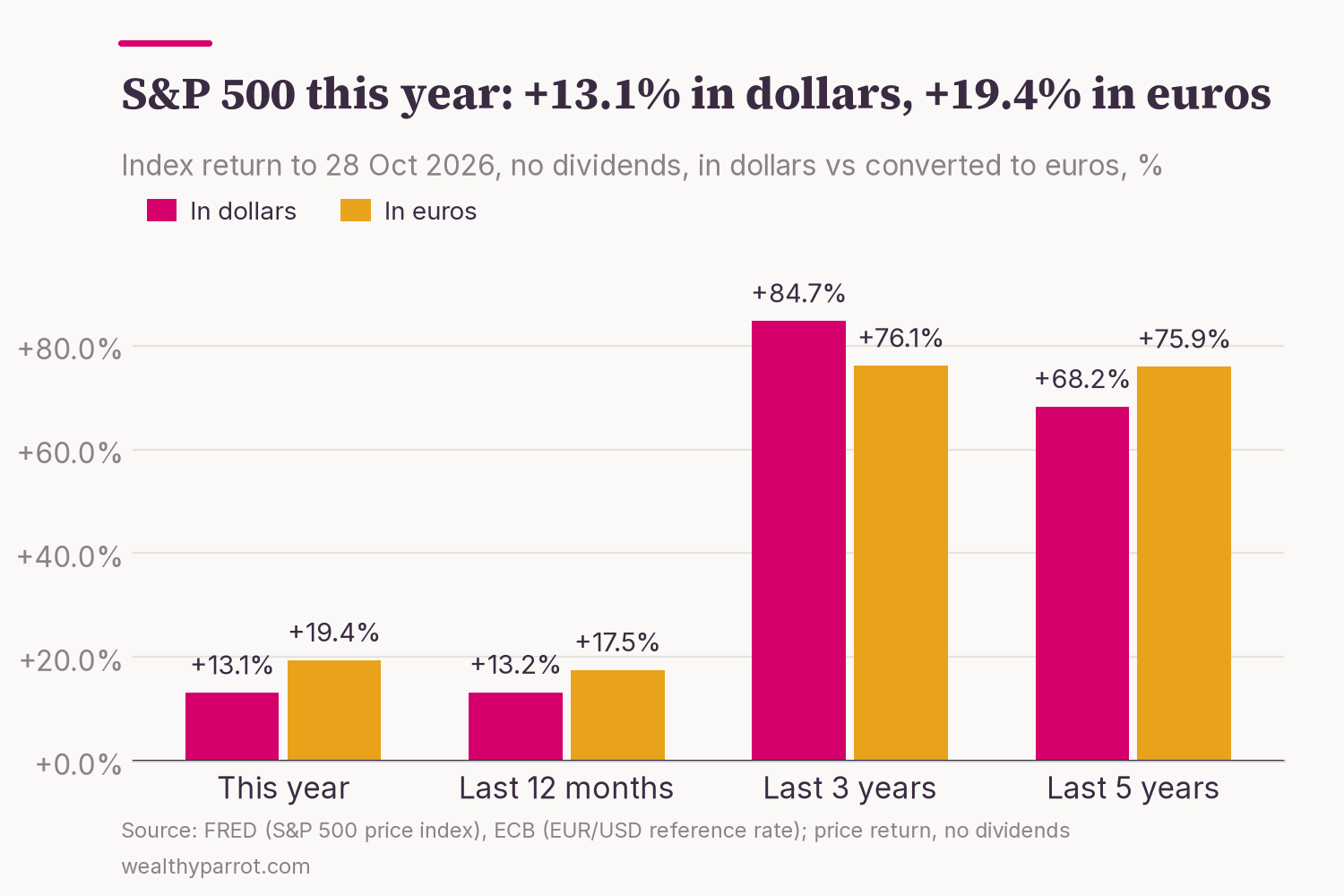
The S&P 500 is an index of 500 large US companies. A US stock fund looks like one investment to a euro saver, but it holds two: the stocks and the dollar. This year the dollar rose against the euro (a euro bought 1.175 dollars at the end of 2025 and buys 1.113 now, per the ECB), which gave euro holders about six extra percentage points on the S&P 500. Over three years it went the other way.
🦜 Parrot's take - Buying US stocks in euros is two bets in one. You only chose one of them.
Second thoughts
The chart raises a question I can't answer yet: should a euro saver hedge the dollar?
Hedging means paying to remove the currency bet, so you only own the stocks. It costs roughly the gap between the two central banks' interest rates. The US central bank (the Fed) has a target range of 3.75% to 4.00% and the European Central Bank's deposit rate is 2.50%, so the gap is about 1.25 to 1.5 percentage points a year. That is my back-of-envelope estimate from two policy rates, not a quote from a hedged fund, which charges its own fees on top.
Next to the chart: the dollar's move added about six percentage points for euro holders this year and took away about eight and a half over three years. A hedge would have cut both swings, at a cost that adds up every year.
I don't know which side of that trade a long-term European investor should be on. If you hold a world fund in euros (one that owns stocks from many countries), do you know whether yours is hedged? Hit reply and tell me what you chose, and why.
One life, one decision
Setup: you're mid-career, the family is gathering for the holidays, and everyone assumes you'll pick a side.
The family knot
An argument between relatives pulls you into the middle. Everyone wants an ally.
- Play peacemaker
- Stay out of it
What would you do? Hit reply - I read everything.
That scenario is from Wealthy Parrot Life, where family, work and money decisions play out across a whole financial life.
One thing
Every story above ends at the same question: where does the money actually go? My book on kakeibo, the Japanese method of budgeting on paper, answers it for your own pay. Kakeibo: Transform Your Finances