Why your concert ticket costs what it costs (and who really keeps the money)


In August 2024, Oasis put their reunion tour on sale and the internet turned into a waiting room. Fans who had seen standing tickets advertised at £148.50 reached the front of the online queue and were asked for £355.20 for the same patch of floor, according to NPR's reporting. Ticketmaster sold more than 900,000 tickets that day. A lot of the people who bought them felt robbed.
Now for the strange part. By the standards of economics, most of those tickets were too cheap.
Why? A concert ticket is underpriced and overpriced at the same time, and both are true for reasons that have very little to do with the band. Once you see how the money moves, you will never look at a "service fee" the same way again.
The ticket was too cheap (yes, really)
Start with a simple test. If a ticket sells out in minutes and then reappears on a resale site at three times the price, what was the right price?
The market just told you. Thousands of people were willing to pay far more than the box office asked. An economist would call the original price below market-clearing, meaning below the level where the number of people who want a ticket equals the number of tickets.
Artists do this on purpose (yes, on purpose). The late Princeton economist Alan Krueger, who spent years studying concert data, called it "block party economics" in his book Rockonomics. A band that charged what the market could bear would look greedy, and fans who feel gouged stop being fans. So artists leave money on the table and protect the relationship instead.
A classic paper on ticket resale made the same point in 2003. When the seller deliberately prices below what the crowd will pay, somebody else steps in to collect the difference. That somebody is the resale market.
Two economists studied the obvious fix. In 2007 Ticketmaster auctioned a small share of seats on 22 tours instead of selling them at a fixed price. At face value those seats would have cost $145 on average, yet identical seats resold on eBay for $136 more, a 94% markup.
The auctions found the real price. Winning bids averaged $274, only about $6 below what the seats later resold for. Resellers were left with almost nothing, and artists roughly doubled what they earned on those seats (spoiler alert, the auctions still died out).
Economists use a simple lab game to show why artists fear looking greedy. In the ultimatum game, two strangers play for real money. The first gets $100 and proposes a split, take it or leave it.
If the second player accepts, both keep their shares. If they refuse, neither gets a cent. Pure logic says accept anything, even $1, because $1 beats nothing.
Real people turn down offers below roughly $30, as Krueger recounts. They would rather walk away from $20 than let a stranger keep $80 for a split that feels unfair.
Fans behave the same way. They will happily pay £150 for a ticket priced at £150, and feel cheated paying £150 for one they saw advertised at £100. The anger is about fairness more than money.
Most acts never face this problem, as a 2026 study of North American concerts found the average musician sold only about 63% of available tickets and sold out just 20% of their shows.
Fun fact: Garth Brooks took the opposite route to the same goal. On his 2014-2017 world tour he set a flat price of about $70 and kept adding shows in the same city until demand ran out, selling 6.3 million tickets, as Krueger documents. He beat the scalpers by making supply bigger than demand.
So for the acts everyone wants to see, the face value is often a choice, set below the real market. Keep that in mind, because the rest of this story is about who captures the gap.
Eleven times the price in 44 years
"Too cheap" and "expensive" can both be true, because prices at the top have climbed at a pace nothing else in your budget matches.
In 1981 the average concert ticket cost about $12, according to the Pollstar box-office data Krueger used. By 2017 it was $69. In 2025 the average ticket for the year's top 100 tours was $132.62, according to Pollstar's year-end analysis.
That is roughly ELEVEN times the 1981 price. The jump flatters a little, because Krueger's figures cover a wide range of tours and the 2025 one only the biggest 100. On Pollstar's own top-100 measure, prices still rose about 38% from 2019 to 2025.
Over 1981-2025, US consumer prices rose about 254%, based on the Federal Reserve's consumer price index. So a $12 ticket in 1981 is worth about $42.49 in 2025 money. Strip out inflation and a big concert still costs about three times what it did in 1981.
Two forces did most of the work.
The first is the superstar effect. Krueger found that the top 1% of performers captured 60% of all concert revenue, up from 26% in 1982. The top 5% took 85%. When everyone wants to see the same handful of acts, those acts can charge more, and the averages drift up with them.
The second force is the one that hit your phone. Recorded music used to pay the bills. Then piracy and streaming turned an album into something closer to tap water (David Bowie predicted in 2002 that music would become "like running water or electricity"). If you have read why Spotify pays 70% of its revenue to record labels, you know how little of that trickles down to artists.
So artists moved their business to the one product nobody can copy, which is a night in a room with them. Among the top 48 touring acts in 2017, about 80% of income came from live shows, according to Krueger. Records brought in 15%.
Fun fact: Paul McCartney made 82% of his income from touring in Krueger's data, and U2 made 96%. Even the most famous catalogue in pop music is now mostly a reason to buy a ticket.
Think of it like a restaurant that started giving the food away and charging for the table. You can stream the album for the price of a sandwich a month. The table is where the money is.
Where your money actually goes
So you pay €100 for a ticket. Who gets it?
The artist usually gets the biggest single slice. Top acts sign deals that give them either a guaranteed fee or a share of the profits, whichever is larger. The profit share for superstars typically runs 85/15 or 90/10 in the artist's favour, according to the music lawyer Donald Passman's standard guide to the business. That share applies to the profit left after agreed show costs, which is a much smaller pot than the ticket money.
The promoter, the company that books the venue, pays for the production and sells the tickets, keeps the rest after costs.
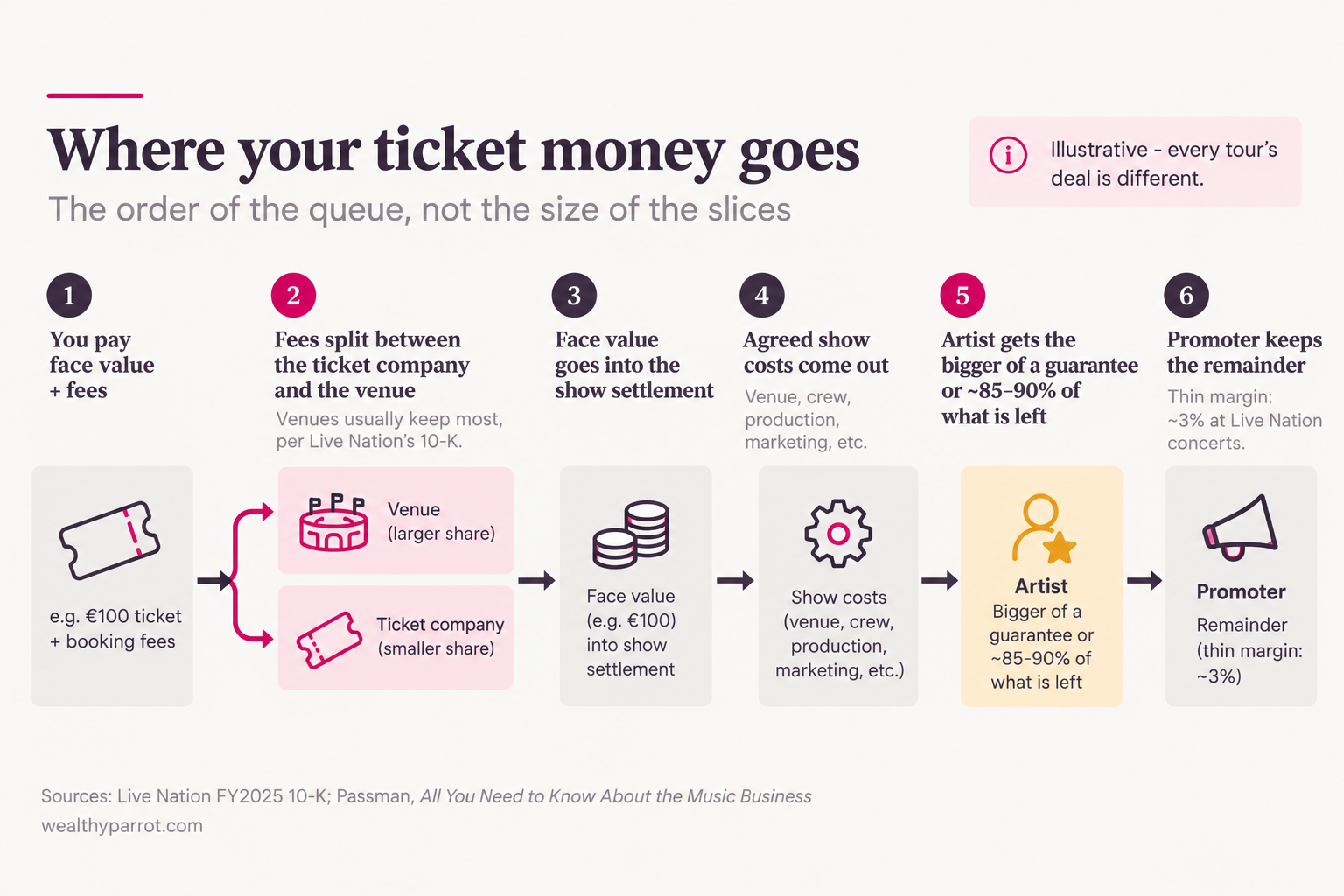
Then come the fees. The face value is not the whole price, and the gap between the advertised figure and the checkout total is where a lot of people's anger lives. In a 2018 US government audit, fees averaged 27% of the ticket price on first sales and 31% on resale, based on a small sample of events. If you have ever been ambushed by baggage charges, you already know the airline version of this trick.
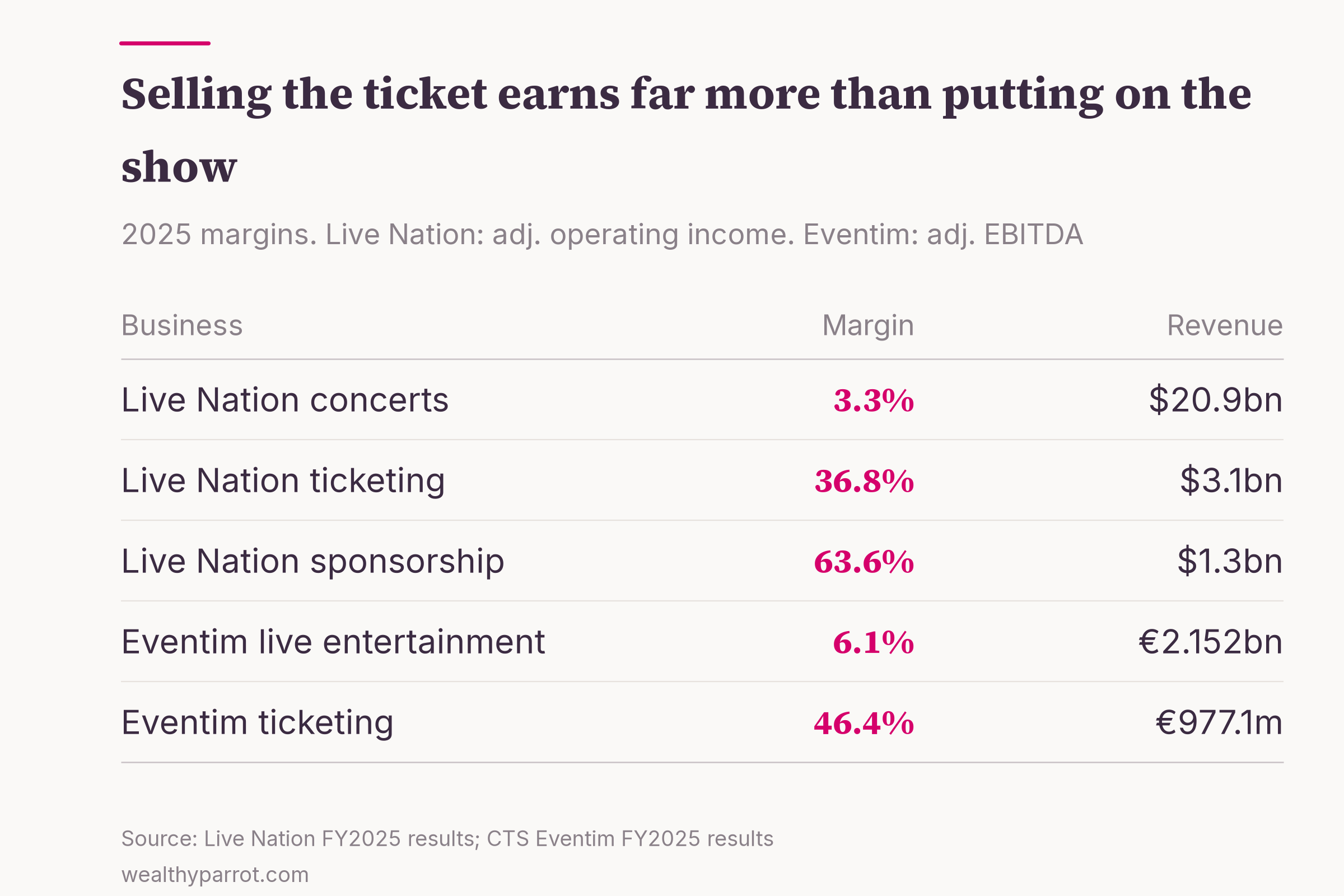
The clearest window is Live Nation, the world's biggest promoter and the owner of Ticketmaster. Its 2025 results split the business into three parts.
- The concerts business brought in $20.9 billion, about 83% of the company's revenue. Its adjusted operating income (the company's own profit measure, before interest, tax and some one-off items) was $687 million. That is a margin of about 3.3 cents on every dollar.
- Ticketing brought in only $3.1 billion. Its adjusted operating income was $1.13 billion, a margin of about 37%.
- Sponsorship and advertising, the logos on the stage and the bank whose card gets you a presale, added $1.3 billion of revenue at a margin of about 64%.
Putting on the show is a thin-margin business. Selling access to the show, and selling the audience to sponsors, is where the profit sits. Ticketing and sponsorship were 17% of revenue and about three-quarters of the profit across the three segments.
Europe's biggest ticket seller has the same shape. CTS Eventim's ticketing business made €977.1 million of revenue in 2025 at a 46.4% margin, while its concert-promotion business made €2.152 billion at 6.1%, according to its annual results. Eventim measures profit slightly differently from Live Nation, but the gap points the same way.
If you have read how McDonald's makes its real money from property, this will feel familiar. The burger brings you in, and the rent pays the bills. In live music the concert is the burger and the fee is the rent, with one twist. Ticketmaster shares the building with the venues, which set the service fee "and typically retain the majority of these fees," according to Live Nation's annual report.
How often do you look at the fee line before you click "buy"? Most of us (me included) glance at the headline price, commit emotionally, and treat the fees as the cost of not missing out. The business is built around that moment.
The second market, and the people who live in it
The gap between face value and what fans will pay does not disappear. It gets collected by somebody, and for decades that somebody was a scalper (a "tout" if you are in Britain).
Resale is a game of musical chairs where the music stops the second a show sells out. Professional resellers use bots, software that grabs tickets faster than any human, then relist them at the market price. A 2019 study on bots and "fair price" ticketing calls the resulting mess a curse. The lower and fairer the face value, the bigger the prize for whoever buys first.
Is resale simply bad, then? A 2014 study of rock-concert tickets found resale improved who ended up in which seat by about 5%, as tickets moved to fans who valued them more. A third of that gain was eaten by the scramble for cheap tickets and the cost of reselling them. Picture a recycling scheme that burns a third of what it saves on running the trucks.
Artists fight back by making resale harder or by capturing the gap themselves. Taylor Swift did both. Fans registered for Ticketmaster's "Verified Fan" scheme and bought through presales, which screened out many bots.
The best seats were priced at a premium, so less of the gap was left for resellers, as Krueger describes. Economists call this price discrimination, charging different fans different prices for roughly the same product.
It worked spectacularly. The Eras Tour sold $2.08 billion in tickets to 10.2 million fans across 149 shows, according to figures from the tour's production company reported by Consequence. That works out to about $204 a ticket.
Which brings us back to Oasis. Everyone called it "dynamic pricing", the airline-style system where an algorithm raises prices as demand rises.
The UK's competition regulator, the CMA, looked into it and said it found no evidence of that. What Ticketmaster had done was simpler. It sold a batch of standing tickets at the lower price and, once those were gone, released the rest at a much higher one. Fans in the queue had no way of knowing which batch they would get.
Fun fact: In the same investigation, the CMA said some seated "platinum" Oasis tickets sold for nearly 2.5 times the price of equivalent standard tickets. The seat was the same. The label was the product.
Who carries the risk
In live music, the risk is spread unevenly, and fans hold more of it than they think.
Promoters carry the first layer. Live Nation books tours four to eight months ahead and "often agrees to pay an artist a fixed guaranteed amount prior to our receiving any revenue," its annual report says. If the tickets do not sell, the promoter eats the loss. That is one reason the concert business runs on such thin margins, and why promoters want to own the ticketing and sponsorship side, where the profit is steadier.
Fans carry the second layer: your ticket is usually non-refundable unless the show is cancelled. If you cannot go, your exit is the resale market, where you may sell below what you paid or meet a fraudster selling a ticket that does not exist.
That last risk is real. UK fans lost more than £1.6 million to gig-ticket scams in 2024, more than double the year before, according to the Home Office. You also carry the risk of the queue itself (deciding in ninety seconds whether £355 is worth it is not how anyone makes good financial decisions).
Artists carry the third layer, which is reputation. This week Sam Fender showed what that looks like. When prices for his 2027 UK stadium tour leaked, with front standing at Wembley at £130.75 including fees, he posted that "I'm not happy with these prices, they're getting changed", Far Out Magazine reported.
Ahead of the general sale on 30 October, front standing was scrapped. Standing tickets are now £85 at every show and seats £55 to £95, though those new prices exclude fees, so they are not directly comparable.
Fender also said ticket prices "should only be inflated in relation to the cost of putting the show on." That is block party economics in one sentence. He chose goodwill over the last pound.
Fun fact: When Radiohead let fans pay whatever they wanted for the album In Rainbows in 2007, 60% of the first million downloads paid nothing. The other 40% paid an average of about $6, and the band netted nearly $3 million, according to Krueger. Fans pay generously when the price feels fair, and walk away angry when it does not.
The final layer belongs to the company in the middle. The authors of Chokepoint Capitalism call Live Nation's model "chickenized", after the poultry giants that own everything from the chicks to the farmer's shed. Live Nation manages artists, promotes their tours, runs venues and sells the tickets.
In March 2026 the US Justice Department settled its case mid-trial and Live Nation kept Ticketmaster, the ABA Journal reported. Most of the states refused the deal. In April a federal jury in New York found that Live Nation and Ticketmaster had illegally monopolised parts of the US live-music business, as law firm Manatt summarised. As of late October the judge has not ruled on Live Nation's request to throw out the verdict, so any remedy, including a Ticketmaster split, is still some way off.
Europe is rewriting the rules
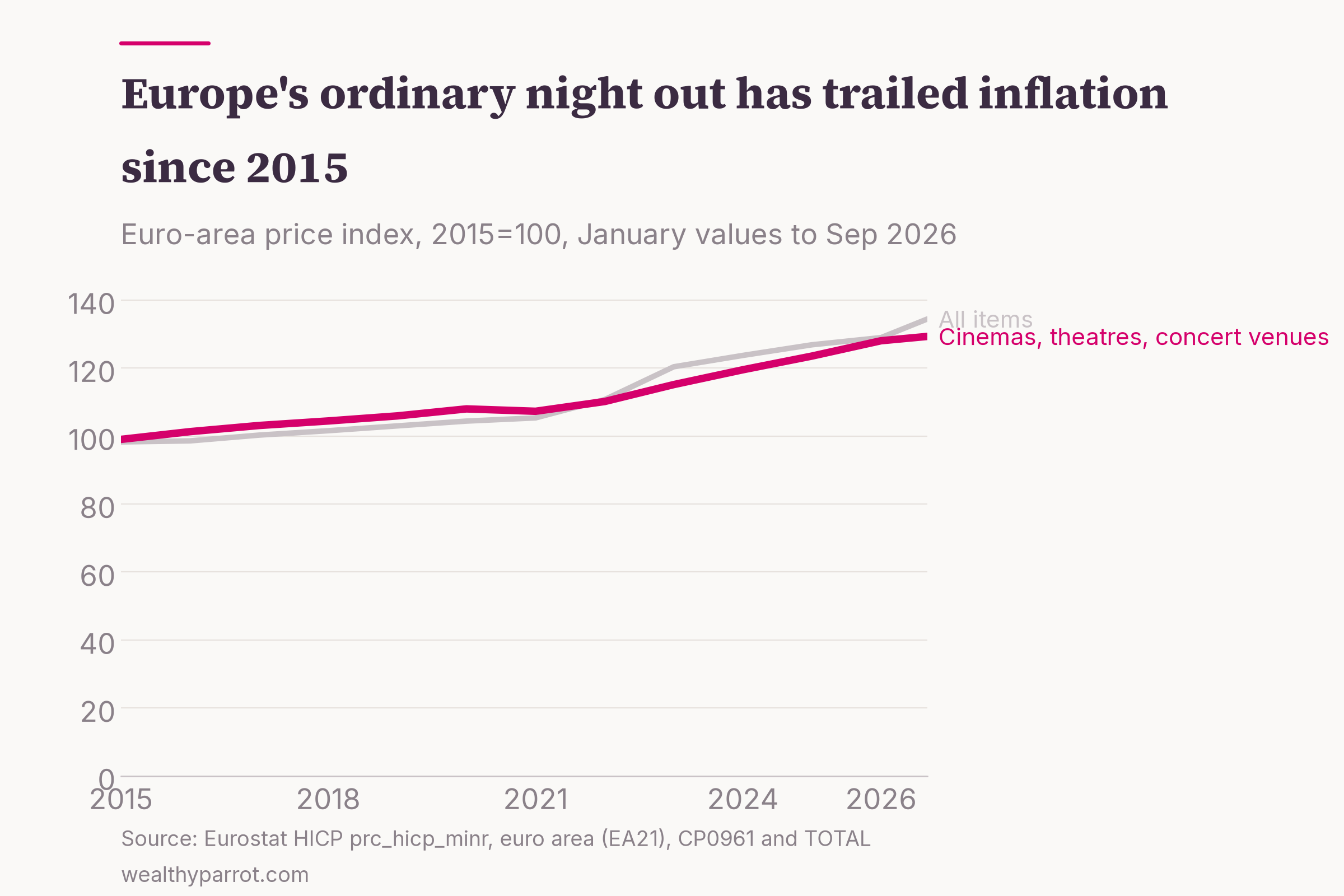
If you live in Europe, start with some good news. Eurostat tracks the price of "services provided by cinemas, theatres and concert venues" across the euro area. From January 2015 to September 2026 that index rose about 31%, while consumer prices overall rose about 37%, according to Eurostat's price data.
The index includes cinema tickets, so it is a broad gauge, but the ordinary night out has roughly kept pace with inflation, and the explosion sits at the very top of the market.
The rules around your next big show are messier, and they depend on which border you buy it inside. Think of it as Parrot Court, with a different verdict in each country.
Ireland bans reselling tickets above their original price for designated events and venues under its Sale of Tickets Act 2021. Sellers face fines of up to €100,000 or up to two years in prison. A TD from the governing Fine Gael party said in May 2026 that there had been no prosecutions in nearly five years, according to the party. My verdict is tough on paper and untested in court.
Italy goes further. Individual fans can resell a ticket they cannot use, but only at face value or below, and only authorised sellers can sell tickets commercially, according to the consumer group Euroconsumers. In 2020 the regulator AGCOM fined Viagogo, StubHub and Mywayticket a combined €5.58 million for selling tickets above face value, its press release says. My verdict is the strictest rules on this list, with real fines attached.
The UK announced plans in November 2025 to ban resale above the original price plus unavoidable fees, and to cap resale platforms' fees. The government estimates resale tickets would be £37 cheaper on average, saving fans £112 million a year. As of autumn 2026 the plan is a draft bill awaiting scrutiny, according to Music Ally.
Meanwhile the CMA's settlement with Ticketmaster in September 2025 means UK fans must now be told 24 hours in advance if tiered pricing will be used, according to law firm RPC.
At the EU level, Euroconsumers is pushing for a Europe-wide ban on above-face-value resale through the planned Digital Fairness Act. That is a campaign rather than a law, at least for now.
Fun fact: The first Glastonbury, in 1970, cost £1 and came with free milk from the farm's own dairy, Radio X recounts. A 2027 ticket costs £408 including a £5 booking fee, the festival's highest price ever, Rolling Stone UK reported.
A cap moves the gap without removing it. When face value is below what fans will pay, the gap goes to whoever is fastest, luckiest, or willing to break the rules.
Practical takeaways
- Compare the all-in price, not the face value. Fees can add a large chunk to the headline figure. Decide your limit on the total before the queue opens.
- Decide before you queue. Pick your maximum price and your fallback (a later date, a seat instead of standing) in advance, so ninety seconds of pressure does not decide for you. A countdown timer is a textbook spending trigger.
- Use official face-value resale first. Many ticket companies run resale exchanges capped at face value. In Ireland, Italy or another country with caps, an above-face listing is a red flag as well as a rip-off, and social media sellers deserve extra suspicion.
- Look for added dates. Big acts often add shows when the first ones sell out. The first release is not always the last chance.
- Treat a concert as a planned purchase. A €130 ticket plus travel is a real line in your budget. If you use a simple system like Kakeibo, give experiences their own category so they do not ambush your month.
- Know your exit before you buy. Check whether you can resell, at what price, and through which platform, in case plans change.
Back to the queue
Think back to those Oasis fans watching the price jump from £148.50 to £355.20. It felt like the price was being set in the queue, by a machine reading their desperation.
It was set long before. The band chose a face value below what the market would pay. The ticketing company chose how to release the tickets and which fees to add.
The resellers had their bots ready for the gap. Everyone in the room had done the maths, except the fan at the front of the queue. Next time, do yours before the queue opens.