Why the jacket you liked at Zara is gone next week
Zara's owner keeps €58.30 of every €100 after paying for its clothes. How small batches, fast refills and scarcity make it so profitable.


You see a jacket at Zara. Good colour, decent price, but you decide to sleep on it. A week later you walk back in, wallet ready, and the rail it hung on is full of something else. Nobody restocked it, and nobody will.
That was not bad luck. It is the most profitable habit in fashion, and you are part of it.
Zara's owner, the Spanish group Inditex, sold €19.8 billion worth of goods in the first half of 2026 and kept €3.0 billion of it as profit, according to its own results. That is about €15 of profit for every €100 you hand over at the till, from a chain famous for being affordable.
So how does a shop that sells €30 tops make that kind of money? The answer starts with the jacket that vanished.
The money question
Start with gross margin, the share of each sale left after paying for the clothes themselves (fabric, factories, freight), but before rent, staff and everything else. It tells you how much pricing power a retailer really has.
Inditex's gross margin for its last full financial year, which ended in January 2026, was 58.3%, according to its annual results. Out of every €100 you spent, €58.30 was left once the clothes were paid for. Its closest rival, Sweden's H&M, reported a gross margin of 53.4% for its own last full year, in its 2025 report. That is €53.40 per €100.
A gap of €4.90 per €100 sounds small. On Inditex's €39.9 billion of yearly sales it is roughly €2 billion, every year.
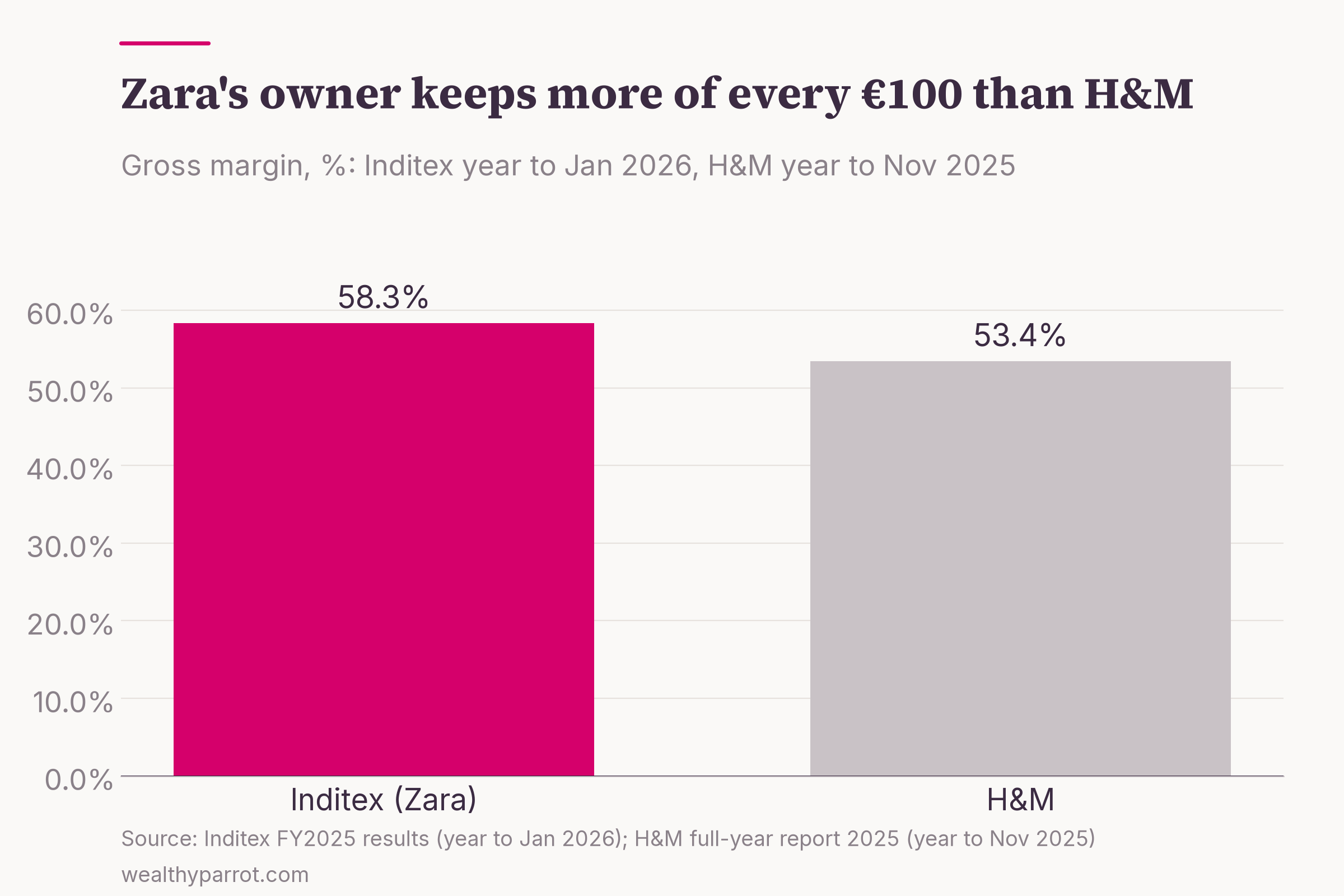
Both companies sell similar-looking clothes at similar prices, made in many of the same countries. The gap does not come from charging more. It comes from having to discount less, and that comes from the way Zara decides how much to make.
How a normal fashion chain works
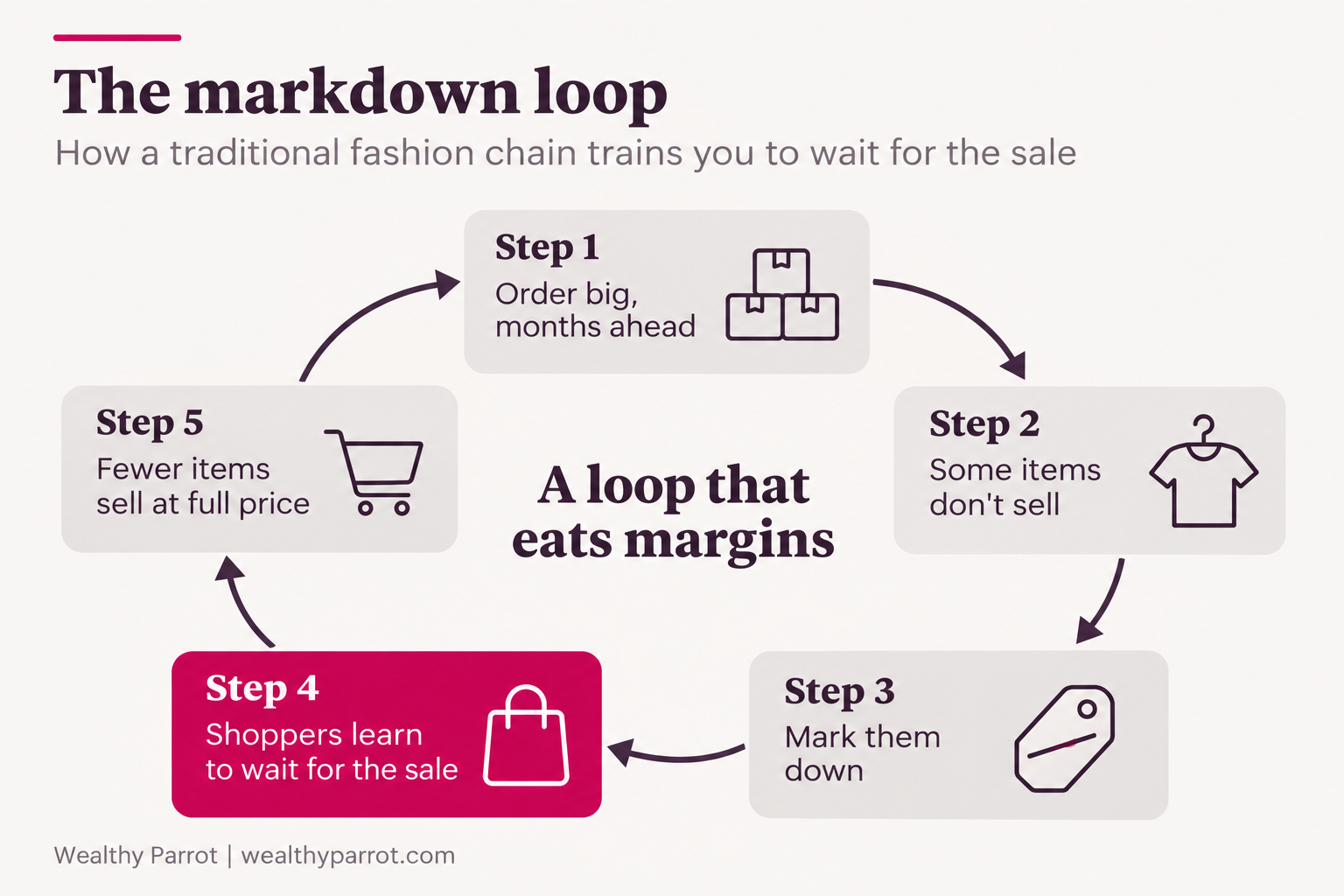
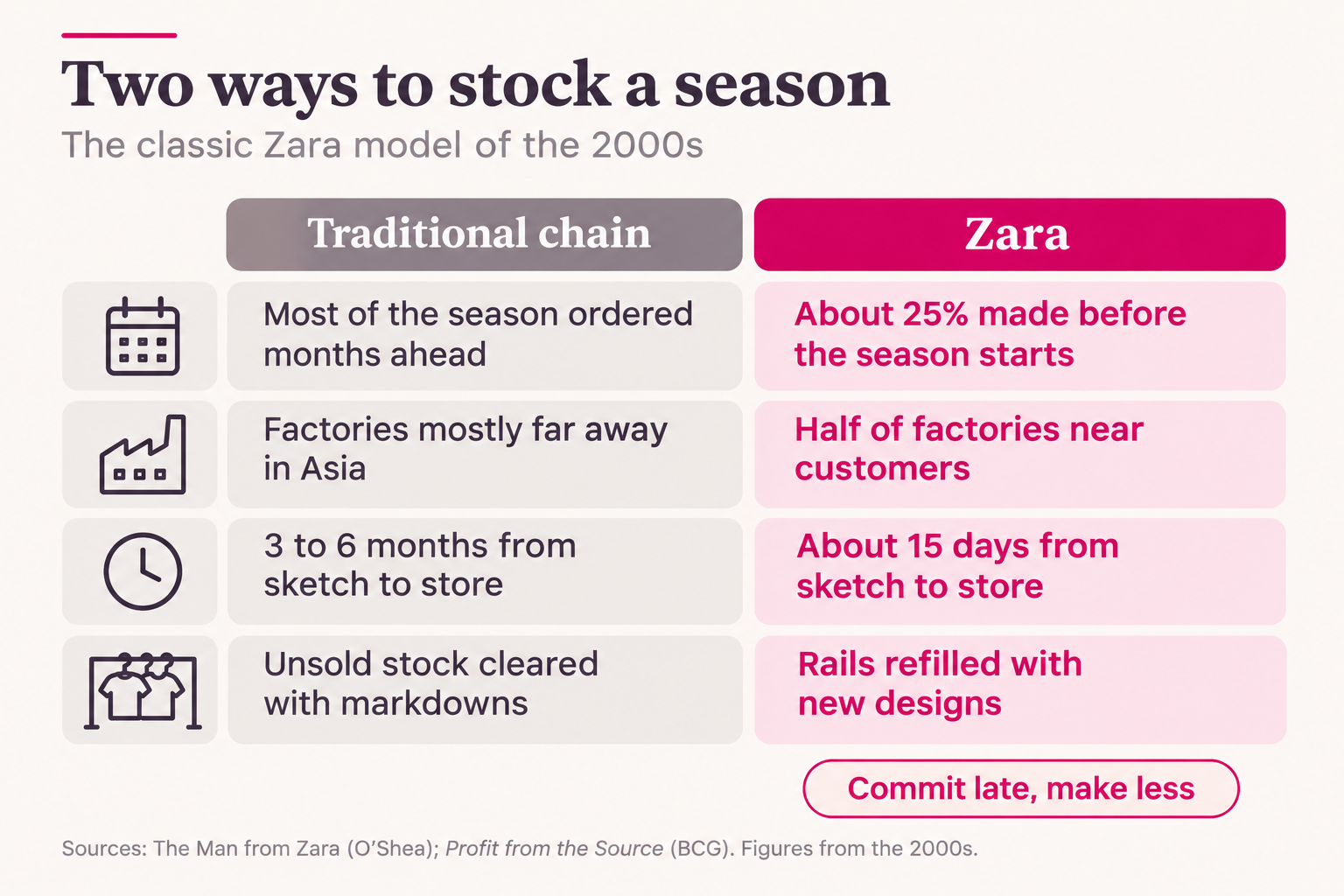
Picture the traditional model first. A fashion house designs its autumn collection a year ahead, guesses how many of each item will sell, and places big orders with factories in Asia months before the season starts. The clothes arrive by ship. Then the season begins, and the guessing game is over.
Some items fly off the rails. Others sit there, and they have to go, because next season's stock is already on its way.
So they get marked down, again and again, until they sell. A markdown is simply a price cut on unsold stock, and in fashion it is where profit goes to die.
Have you ever bought something in a January sale and thought you were beating the system? In a sense, you were. You were collecting the cost of someone else's bad forecast.
The old model got so used to this that the discount became the normal price. By 2005, shoppers in the US were buying about 60% of department-store clothing on sale, according to the journalist Elizabeth Cline's book Overdressed. In The End of Fashion, Teri Agins describes how department stores even made designer brands pay them rebates when their clothes sat unsold on the markdown racks. The trade called it "markdown money" (yes, the bad forecast had its own invoice).
Economists have a name for shoppers like that. Two researchers built a model of a fashion season with two kinds of players. The retailer decides how much to make and when, and the shopper sees an item at full price and decides whether to buy now or gamble on finding it cheaper in the clearance. They called the shoppers who wait strategic consumers.
The more a chain overproduces, the more it trains its customers to wait, and the more of its stock ends up sold at a discount. It is a loop, and it eats margins.
How Zara breaks the loop
Zara's answer is to guess as little as possible, and it comes from an unusual place. Amancio Ortega started work at 12 or 13 at a shirtmaker's in A Coruña, in Galicia, and opened the first Zara store there in 1975, at the age of 40. He was a shop assistant before he was a manufacturer, and he never stopped thinking like one (his biographer quotes a business leader calling it "the mentality of a shop assistant").
In the early years, more than half of Inditex's collections were made in its own factories and in cooperatives in Spain and Portugal, according to the book. In 1990 one magazine counted some 6,000 Galician village women sewing for the company in cooperatives. Factories close to the shops meant that a reorder could arrive in days, not months.
The idea itself was American. In the 1980s, US garment makers adopted "Quick Response", making smaller batches faster to fight cheap imports. According to the journalist Dana Thomas in Fashionopolis, Ortega borrowed it for Zara. A US invention against foreign competition became the weapon of a foreign competitor.
When Covadonga O'Shea wrote her biography of founder Amancio Ortega, The Man from Zara, only about 25% of a collection was made before the season opened. Around 65% of the fabric was ordered in advance, and the rest was held back until the company saw what customers were actually buying.
The rest of the collection was made during the season, in small batches, and much of it close to home. A consulting team at BCG, writing in Profit from the Source, described the formula in three parts.
Half the factories sit near customers in Europe and half in Asia. Spare factory capacity is kept idle on purpose, and only half of the inventory is committed in advance. That is how a new design could go from sketch to store in about 15 days, against three to six months for a traditional fashion house.
Inditex still describes its own model, in its 2025 results, as "flexibility, responsiveness and within-season proximity sourcing". In 2022, the last year it published the figure, 49% of the factories that made its garments were in Spain, Portugal, Morocco or Turkey.
You may read elsewhere that most of Inditex's factories are now in Asia. A Modaes analysis of the 2025 annual report counted 61.83% of its 6,684 supplier factories there, but that count covers every stage, including spinning and weaving, not just the factories that sew the final garment. The principle has not changed. Commit late, make less, and let the shops tell you what to make next.
Think of it like a restaurant that cooks to order instead of preparing a buffet in the morning. The buffet always throws food away. The kitchen that cooks to order rarely does, even if each dish costs a little more to make.
Fun fact: Amancio Ortega has never had an office. According to his biographer, his workstation is a desk in the big open hall where Zara's designers and commercial teams work, and he spends his days walking between factory, warehouse and design floor.
The shop floor is the forecast
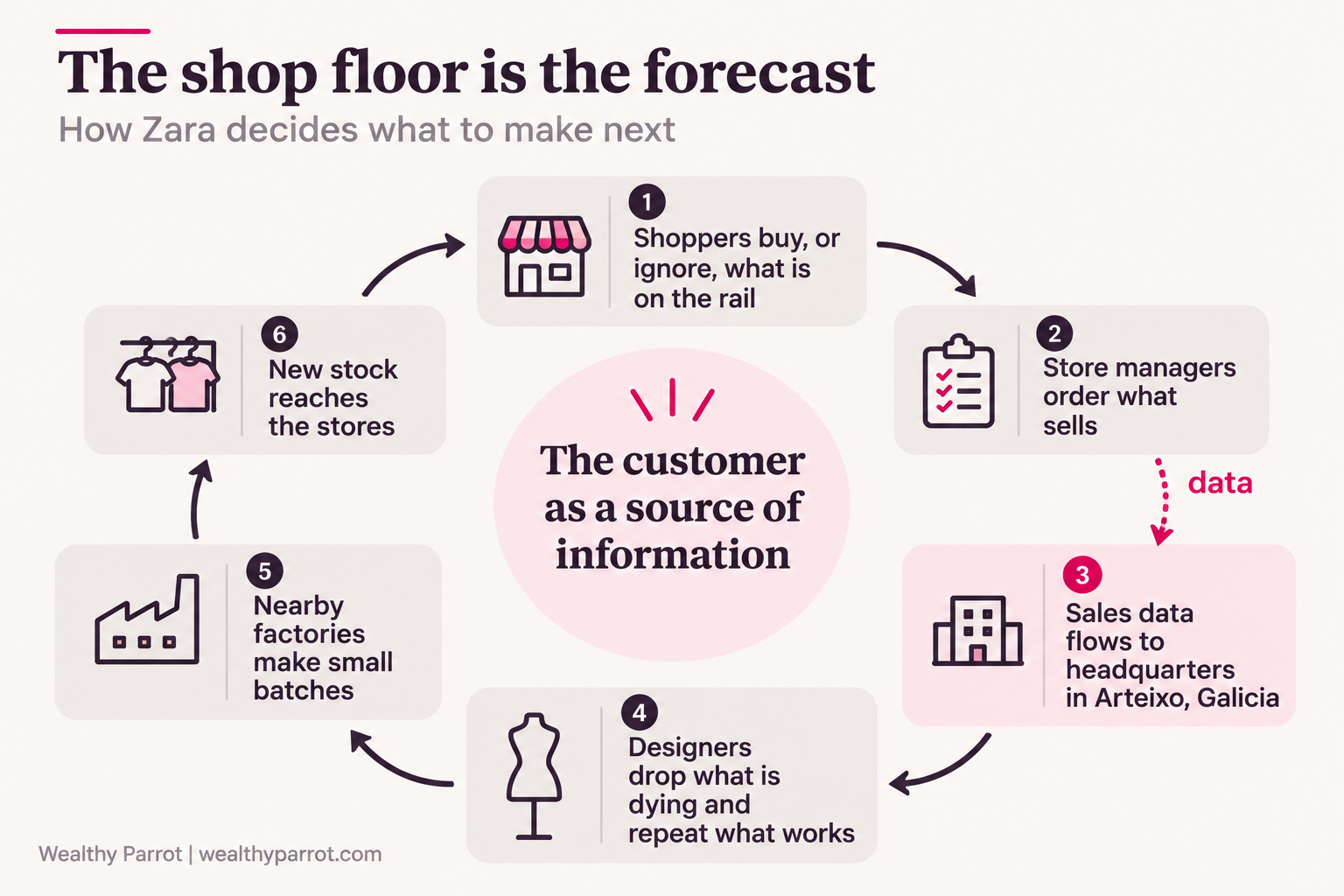
The second half of the trick is information. In a traditional chain, head office decides what each store gets. At Zara, the store managers order, and the sales data from every shop flows back to the design teams at headquarters in Arteixo, Galicia.
If a skirt sells out in Milan and Madrid on Tuesday, the designers know on Wednesday. If a coat is dying in every store, nobody makes any more of it. The customer, as Ortega liked to put it, becomes "a source of privileged information" rather than just the person at the till.
The logistics side has been studied in detail, and not by an admiring journalist. Zara worked with operations researchers to rebuild the model that decides how much of each size goes to each of its stores from its central warehouses. A peer-reviewed account of the project, including a controlled field experiment, estimated that the new system raised sales by 3% to 4%. In retail, that is an enormous number for a spreadsheet change.
The book has the best illustration of what this is worth. After the attacks of 11 September 2001, New York's colourful autumn collections stopped selling overnight. According to O'Shea, Zara was the one chain that could refill its stores with darker clothes within weeks, because it had not committed the season months in advance.
Fun fact: The manager of a large Zara store can earn up to €240,000 a year, according to the book, and almost every key position in a new store goes to someone promoted from inside. Zara treats each shop as a small business with its own boss.
Why waiting for the sale doesn't pay at Zara
Now go back to the jacket. If Zara only made a small batch, and the rail is refilled with new designs instead of more of the same, then waiting is a losing strategy. The item you want may never be marked down, because it may never be there long enough to need it.
When the book was written, stock in Zara's European stores was renewed twice a week, and the whole range changed roughly every 28 days. According to a 2015 Business of Fashion profile quoted by Thomas, a style that does not sell within a week is pulled from the floor and its factory orders are cancelled.
Customers learned the lesson fast. Inditex told O'Shea that Spanish shoppers visited its stores 17 times a year, against 3.5 times for other fashion chains. It is a company figure from the late 2000s, so treat it as an illustration (sadly, nobody has published a newer one).
This is exactly what the strategic-consumer research predicts. The same modelling study found that quick production combined with better-targeted design makes customers less willing to wait for a clearance. They value the item more, and they are less sure it will still be there.
Zara does not have to fight the bargain hunter. It quietly removes the reason to be one.
Zara does still hold end-of-season sales in many countries (yes, the sale rack exists). It just needs them far less than a chain that ordered its whole season a year ago.
Who gets paid
Follow the margin and you find three winners.
The first is Inditex itself. Less unsold stock means fewer markdowns, and fewer markdowns mean that 58.3% gross margin. Zara, together with Zara Home and the budget chain Lefties, brought in €28.1 billion of the group's €39.9 billion of sales in 2025. That is about 70% of everything the group sells.
The second winner is the balance sheet. Inventory is the stock a retailer has paid for but not yet sold, and it is money tied up on shelves and in warehouses. At the end of January 2026, Inditex held €3.2 billion of it, or about €8 of stock for every €100 it sold in the year. H&M reported stock worth 15.5% of its yearly sales at the end of November 2025, or €15.50 per €100.
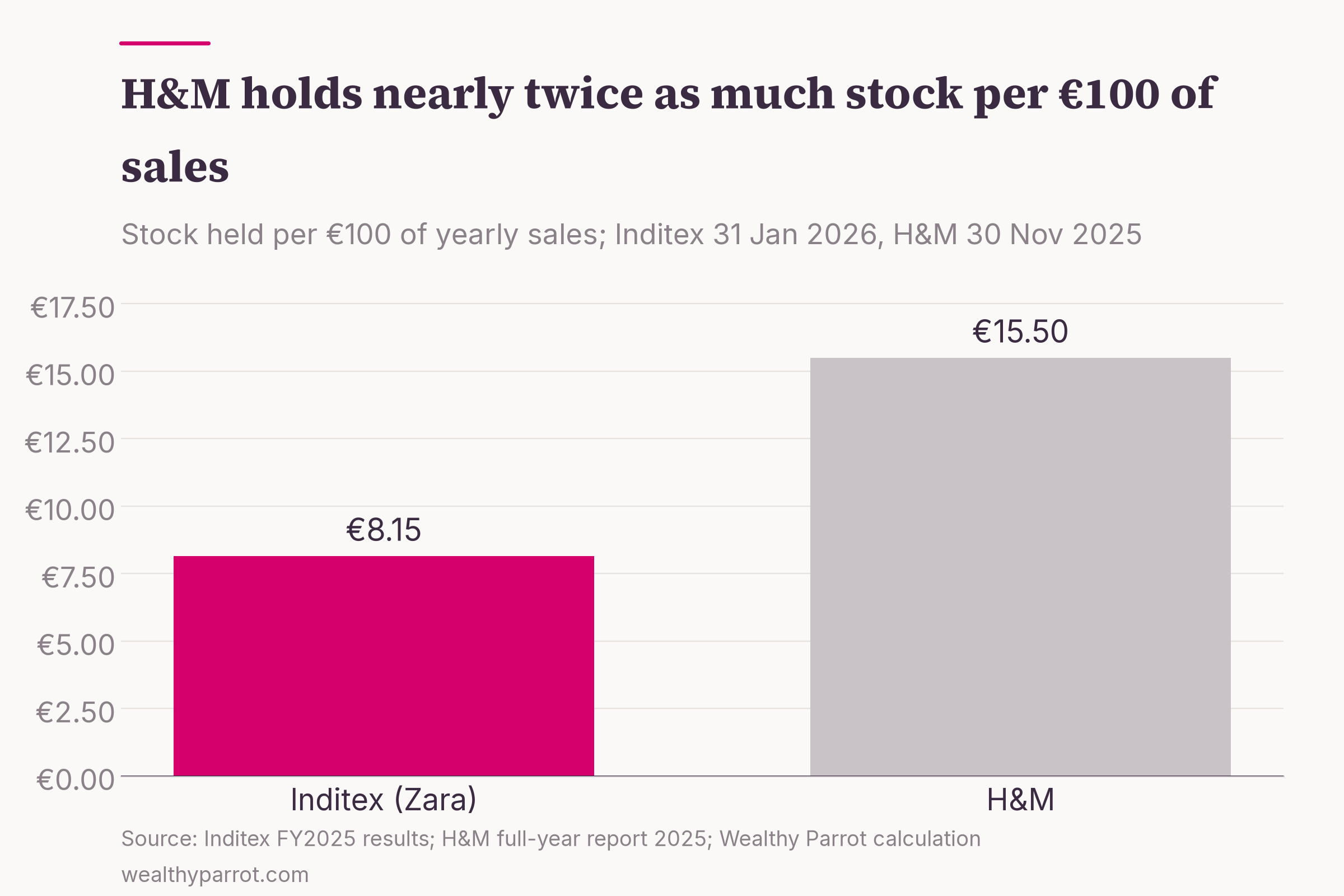
The two dates are two months apart, and fashion stock swings with the seasons, so read that as a rough comparison. The direction matches older evidence: Cline reported that unsold items made up under 10% of Zara's stock, against an industry average of 17% to 20% (a 2012 figure). Unsold clothing is the raw material of markdowns.
The third winner is the shareholder, and above all the founder, who kept the majority of the company when it listed in 2001. When Inditex floated, every employee received 50 shares for each year they had worked there, from pattern makers to managers, according to the book. Shoppers pay for all of this (and honestly, most of them do it happily).
Who carries the risk
A business this efficient pushes risk somewhere, and it is worth asking where.
Some of it sits with suppliers. Keeping factory capacity idle so that Zara can order at short notice costs money, and producing near Europe costs more per garment than producing in Asia. The book argues that Inditex accepts those higher costs because selling at full price more than pays for them. That is a calculation that works for Zara as long as the suppliers can live with the swings.
Some of it sits on the shop floor, because just-in-time stock needs just-in-time staff.
In Worn Out, a 2023 study of US fast-fashion workers, the sociologist Madison Van Oort interviewed a Zara employee in Manhattan earning $12.75 an hour. His rota was meant to go up two weeks ahead and usually appeared two or three days before. Another former worker said the whole floor layout changed every two weeks.
Some of it sits further down the chain. The fast-fashion industry as a whole has a long record of factory disasters and labour abuses, and Inditex has not been immune.
The book describes the collapse of the Spectrum factory in Savar, Bangladesh, where Inditex had a small order of 30,000 children's polo shirts that a trader had moved there without permission. It credits Inditex with setting up a relief fund for victims that other brands resisted. That account comes from an admiring biography, so it is one side of the story, and the wider questions about how cheap fashion gets made have not gone away.
Some of the risk sits with Inditex too, because the trick is no longer a secret. H&M's latest annual report says it is buying "a higher share of product purchases in current season", which is the Zara playbook in one line.
Shein went further. A study of its suppliers in Guangzhou cites research showing Shein adding more than 2,000 women's-wear items to its online catalogue a day, against 43 to 57 for Zara. Researchers at Cornell, Stanford and Monash call this "ultra-fresh" fashion: constant novelty creates demand by itself, which lifts profits and suits shoppers, with an environmental bill that grows if nobody checks it.
And some of the risk sits with you. A model built on "buy it now or lose it" is a model built on impulse. Researchers who interviewed shoppers and store managers in fast-fashion stores found that deliberate scarcity creates an urgency to buy that spills into stranger behaviour. Shoppers described grabbing items in bulk to decide later, and even hiding clothes in the store so nobody else could take them (store managers, interestingly, never mentioned the hiding).
If you have ever bought something at Zara mainly because you were afraid it would disappear, you have felt the business model working on you.
Fun fact: Giorgio Armani once offered to sell his company to Inditex, according to Inditex's former chief executive. The talks fell apart because Armani wanted to sell the business without the name, and, as the book puts it, "the product without the brand name has no meaning."
What changes for you
None of this makes Zara a villain. Selling people what they actually want, quickly, with less waste from unsold stock, is a good business and in some ways a better one. It is still worth noticing which part of the model is aimed at your wallet.
Scarcity is a sales tool, and it works on everyone, including people who know about it (knowing the trick and resisting it are, sadly, different skills). The trick is to make it work for you instead of against you. If you want a refresher on why our brains fall for this, I wrote about it in Discover your spending triggers.
Fun fact: In 1900 the average American family spent over 15% of its income on clothes, about $108 out of $750 a year, according to US Labor Department figures quoted by Cline. By 2009 the share was under 3%. Clothes got cheap enough to buy on a whim, which is exactly when whims start to add up.
The useful question is how many times you will actually wear something. A €30 top worn three times costs €10 per wear. A €90 coat worn 60 times costs €1.50. The cheaper item is often the more expensive one, and Zara's model is very good at selling you the €30 top before you have done that sum.
Small, frequent buys are also how lifestyle inflation sneaks in without ever feeling like a big decision.
It also helps to know which shop you are in. At a chain that overproduces, waiting for the sale is a sensible strategy. At Zara, waiting usually means missing the item, so the real choice is between buying now and not buying at all. Not buying at all is underrated.
Practical takeaways
- Treat "it will be gone next week" as true at Zara, and as a reason to decide calmly, not quickly.
- Use a two-visit rule for anything over a set amount, say €50: leave the store, and only buy it if you still want it the next time you pass by.
- Do the cost-per-wear sum before you pay. Price divided by the number of times you will honestly wear it.
- Keep a short list of what you actually need. A store that changes every two weeks is designed to make you browse.
- If you like a brand's business as much as its clothes, remember that its shareholders profit from your impulses. Owning a broad world index fund is one way to be on that side of the till too, without buying a single jacket.
The rail that was refilled
The jacket you liked was never supposed to stay. It was a small batch, made late, sent to the stores that asked for it, and replaced by whatever the data said would sell next. Its disappearance is part of how Zara's owner keeps €58.30 of every €100 after paying for the clothes.
Next time a rail at Zara empties before you have decided, take it as a small lesson in how the company makes its money. Then ask yourself whether you wanted the jacket, or just did not want to miss it.