One more year at work: what it buys you, and what it costs


Every January, the same spreadsheet opens. You're 50, the portfolio says €900,000, and you spend €38,000 a year. By every rule of thumb you've read, you could stop. And for the third January in a row, the spreadsheet says one more year.
The FIRE crowd calls this loop one more year syndrome. FIRE stands for Financial Independence, Retire Early, and its followers save hard to stop working decades before the official retirement age. On r/financialindependence, a 30-year-old with $1.3 million invested recently asked strangers whether a job they hated was worth another year. On r/EuropeFIRE, the same question turns up in euros every few weeks.
The decision looks simple. You quit now, or you work one more year. Most people answer it by counting only one side of the trade. I want to count both, with real numbers on each side.
The finish line that keeps moving
The common answer is that more money is always safer. Markets can crash, you might live to 100, care might get expensive. One more year means one more salary, one more round of contributions and one more year of growth. Who could argue with a bigger cushion?
That answer is right about everything it counts. It's incomplete because of what it leaves out. A year at work costs something you can't buy back, and the safety it buys shrinks every time you buy more of it.
The ancient Greeks had a puzzle for this. Picture Achilles, as Zeno of Elea did, racing a tortoise that had a head start. Every time Achilles reaches the spot where the tortoise was, the tortoise has crept a little further, so Achilles never catches it.
A retirement number behaves the same way. You hit €900,000, then €1 million starts to sound safer. Then the market has a good year and €1.1 million looks reachable. The tortoise keeps moving because you're the one moving it.
The authors of Quit Like a Millionaire put the trap in one line: "The Scarcity Mind-set trades life energy for survival. The Hoarding Mind-set trades life energy for nothing." Once you have enough, the extra years fall into the second category - unless the maths says you don't have enough yet. So let's do the maths.
Fun fact: In Die with Zero, Bill Perkins turns unspent money into hours of work. In one example from the book, $130,000 left unspent at a net pay of $19.56 an hour comes to 6,646 hours - about two and a half years of full-time work, done for free.
What one more year buys
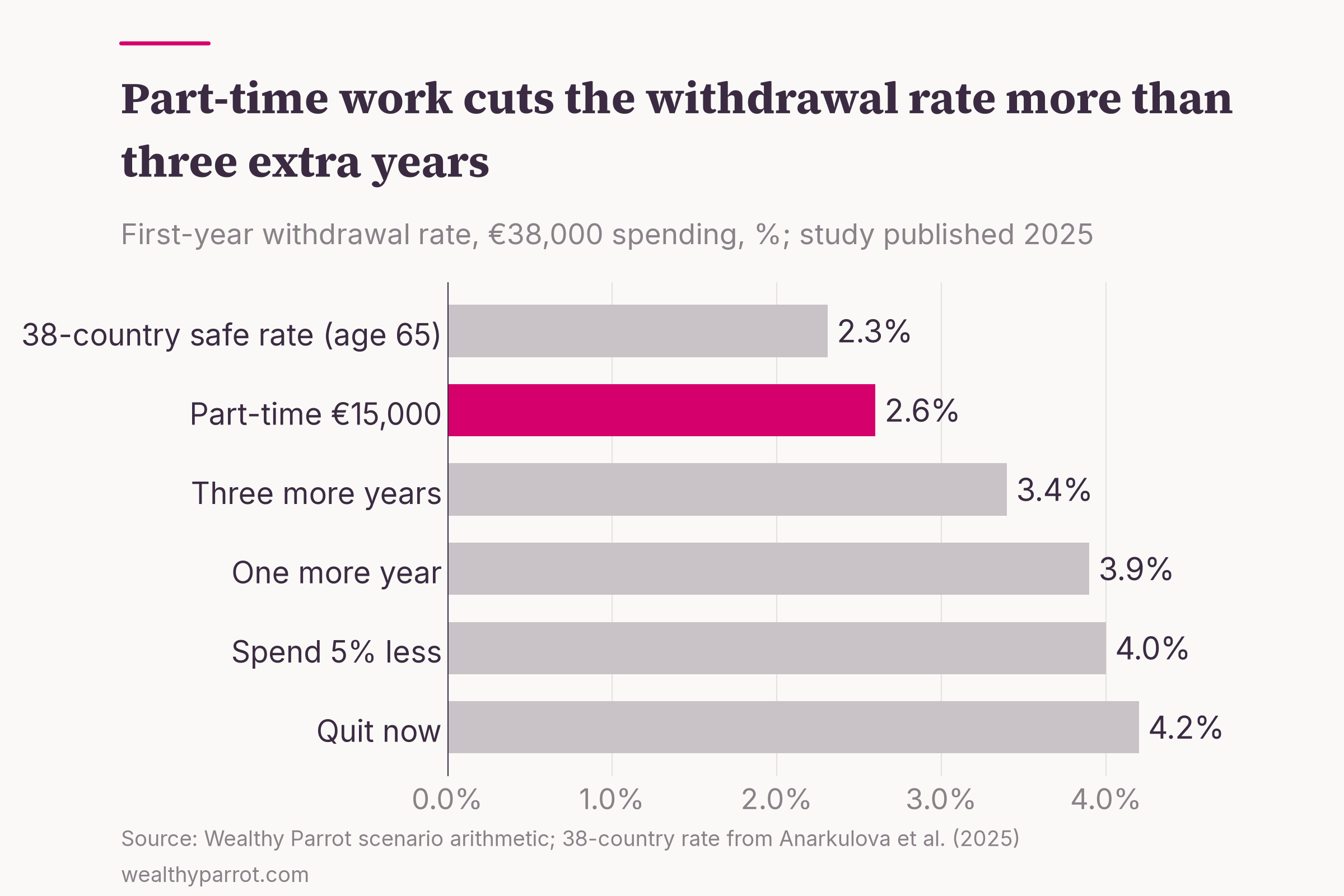
Start with the benefit. You're 50, with €900,000, spending €38,000 a year. That's a withdrawal rate of 4.2%, meaning the share of the portfolio you take out in the first year (after that, you raise the amount with inflation).
Suppose one more year at work adds €30,000 of savings, and the portfolio grows 4% after inflation. At the end of the year the pot is €966,000, and the same spending is 3.9% of it. A second year takes it to about €1,035,000 and 3.7%. A third gets you €1,106,000 and 3.4%.
What are those rates worth? To find out, I ran a backtest, which means replaying a strategy through real history to see how it would have done. The data is Aswath Damodaran's annual US return series from 1928 to 2025, published by NYU Stern. Here are the rules before the results.
The portfolio is 60% US stocks and 40% 10-year US Treasury bonds (loans to the US government), rebalanced every year, meaning you sell a little of whichever did better to get back to 60/40. You withdraw the same inflation-adjusted amount at the start of each year for 40 years, to age 90. A retirement "survives" if the money never runs out. The data allows 59 different 40-year retirements, starting in every year from 1928 to 1986 (they overlap heavily, so read the results as a history count rather than a probability).
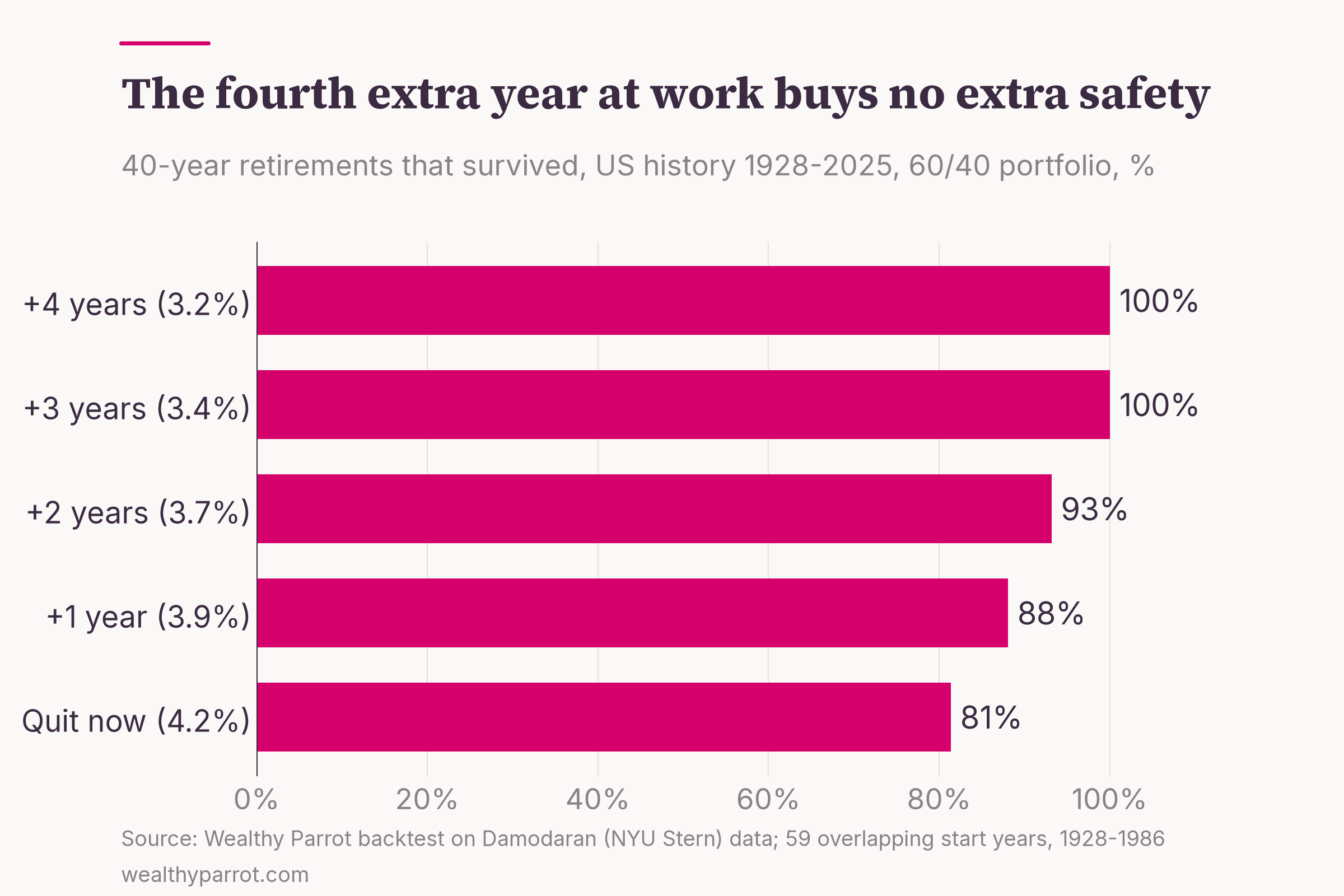
The first extra year buys seven percentage points of historical safety. The third closes the gap entirely. The fourth buys nothing (yes, I checked), because no plan can survive more than every history on record.
I kept the horizon at 40 years throughout. Retiring later shortens it, so the real gains from each extra year are slightly bigger than the chart shows.
Think of a gamer grinding, which means replaying the same level for experience points long after the character is strong enough to beat the final boss. Year four is the grind.
The failures aren't random, either. All 11 failed retirements at 4.2% started in 1937 or between 1962 and 1973. Those were people who quit just before the long inflation of the 1970s ate their bond returns. In every other starting year, the plan worked.
And most did far better than survive. In 32 of the 59 histories, the 4.2% retiree reached 90 with more money in real terms (after inflation) than on the day they quit.
Even the failures were slow. The worst ones took 24 years or more to run dry, and each had lost half its real value by somewhere between year 7 and year 13. That's a long warning, with plenty of time to adjust spending. I covered the tools for that, from spending rules to cash cushions, in how you actually withdraw the money.
There's one big catch, and it matters most for European readers. My backtest uses US history, and the US had the best stock market of the 20th century. A 2025 study across 38 developed countries tested the same kind of fixed, inflation-adjusted withdrawals on a much wider set of histories.
Its answer is sobering. A 65-year-old couple willing to accept a 5% chance of running out could take just 2.31% a year. A 50-year-old has a longer road ahead, so the safe rate wouldn't be any higher. On that evidence, 4.2% is a bet that the future looks like America's past (one more reason I'd invest globally rather than at home).
Fun fact: Bill Bengen came up with the 4% rule in 1994 (spend 4% of the pot in year one, then raise it with inflation). He now puts the historical worst case at 4.7% for a 30-year retirement with a broader mix of assets. In A Richer Retirement, that figure comes from a single unlucky starting month, October 1968; just one of the 349 retirees Bengen tested on full historical data had it that bad. My simpler two-fund version is harsher (its 30-year worst case is 3.7%), which is why I use it here.
What one more year costs
The benefit side is measured in percentage points. The cost side is measured in years of your life, and these years aren't interchangeable.
Eurostat, the EU's statistics office, tracks healthy life years, meaning how long people can expect to live without illness or disability limiting their daily activities. Its latest figures are for 2024. At 50, the average EU resident can expect 33.1 more years of life, and 20.4 of them healthy. At 65, it's 20.2 more years, and only 10.3 healthy, about half.
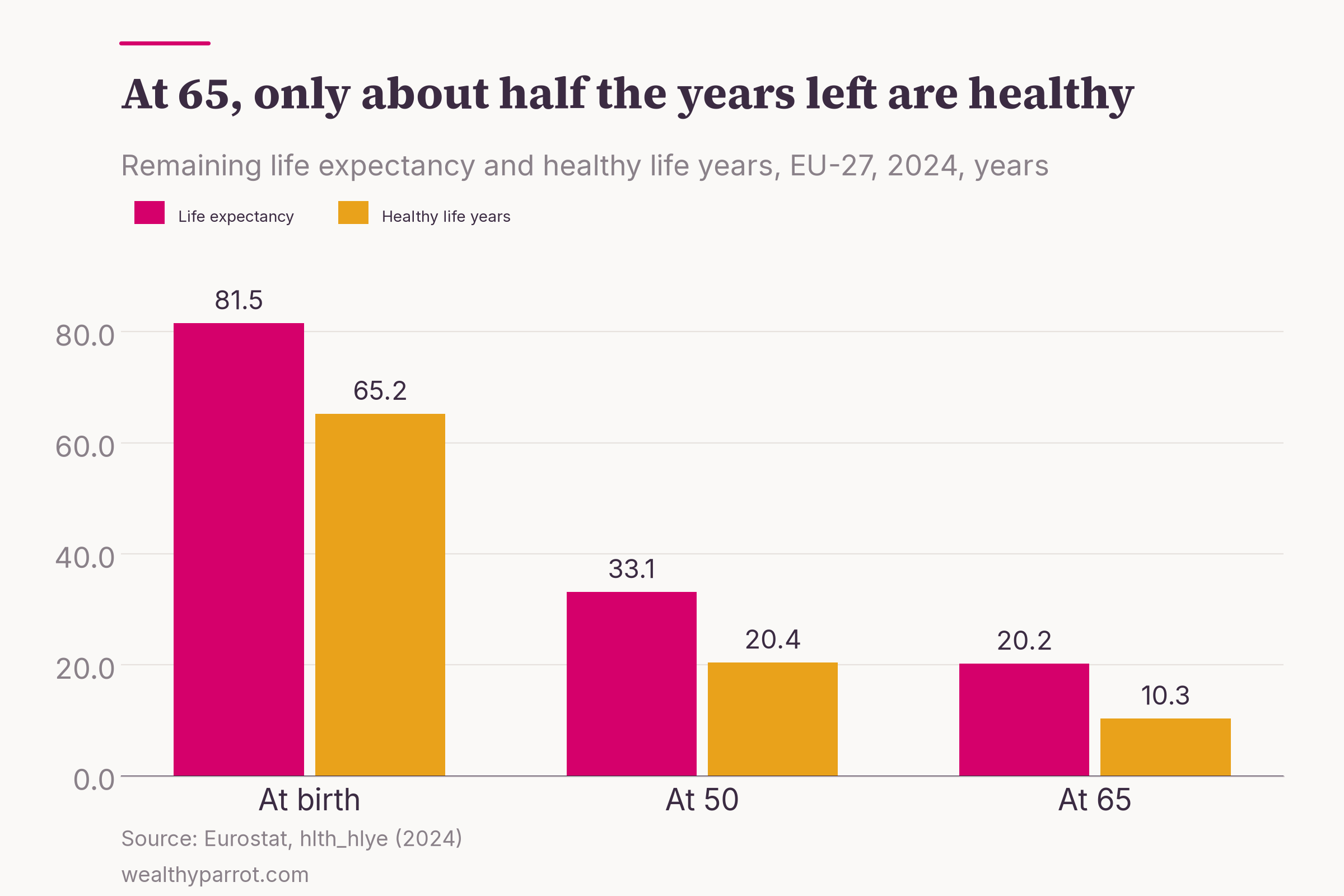
So between 50 and 65, the healthy years left fall from 20.4 to 10.3. Fifteen calendar years go by, and about ten healthy years are used up (my arithmetic on Eurostat's averages). For most people at 50, one more year at work is spent out of an expected window of roughly twenty healthy years.
What could you do at 40 that you can't, or won't, do now? Maybe a long trek, a month away with kids who still wanted to come along, or a sport your knees have since retired from. Your answer is the price list for the years ahead.
Money also buys less when you're unwell. Three economists tracking older Americans measured how health changes the marginal utility of spending, which is the economist's term for how much good the next euro does you. A typical-sized step up in chronic illness cut it by 10% to 25%.
Put those together and the trade gets lopsided. The euros from the extra year get spent later, by an older and probably less healthy you, who gets less out of each one. Francesco Narmenni, an Italian writer on early retirement, compares living only for the future to skating on thin ice. You're like a skater with eyes fixed on the far shore while the surface underneath melts.
To be fair to the office, retiring isn't a pure health upgrade. A 2026 German study used a reform that pushed women's earliest retirement age from 60 to 63, so some retired years earlier than others for reasons unrelated to their health.
Each extra year of retirement lowered fluid intelligence scores (quick problem-solving, as opposed to accumulated knowledge) by about 13% of a standard deviation. The same retirees had fewer diagnoses of hypertension, depression and sleep problems. The authors suspect the culprit is less mental engagement, which a part-time job or a demanding hobby can also supply.
Fun fact: According to the same Eurostat dataset, a baby born in the EU in 2024 can expect to live 81.5 years, 65.2 of them in good health. On average, about 16 of those years come with some limitation on daily activities.
You'll need less than you think
The other half of the "more is safer" answer assumes you'll spend in retirement what you spend now. European data says you probably won't.
A 2009 study of Italian households found a neat way to isolate the effect of retiring. The researchers compared households just before and just after they qualified for a pension, so the main thing changing was retirement itself. Spending fell by 9.8% at retirement.
It wasn't money trouble, because the drop showed up for better-off households too. Lower work-related costs accounted for part of it (think commuting, work clothes and lunches out). Most of it came from something else entirely.
Fun fact: In that Italian study, the biggest single reason household spending fell at retirement was grown children moving out of their parents' home. (I'll leave you to decide whether a parent who is home all day is the cause.)
Now apply a cautious version to the €900,000 plan. Assume only half the Italian drop applies, about 5%, because there are no adult children in the spare room. €38,000 becomes €36,100, and the withdrawal rate on €900,000 falls from 4.2% to 4.0%. That's most of what the first extra year buys - for free, just by spending the money you'll naturally stop spending.
The year you might not get to choose
"One more year" assumes you get to pick. Plenty of people don't.
In the US, a ProPublica analysis of a long-running national survey found that 55% of people who retired in 2014 said their retirement was forced or partially forced. Europe looks better, but not safe. A 2025 study using SHARE, a long-running survey of people over 50 in Europe, covered ten countries. It found that 16% of people who retired between 1996 and 2005 called it involuntary (being laid off, for example), against 10% of those who retired between 2006 and 2015.
So the plan quietly assumes that your body and your employer both agree to the extra year. It's like a game of musical chairs where you assume the music will wait for you. If either one says no, you retire anyway, on someone else's schedule.
Try this test. If your job ended next Friday, would your numbers still work? If the answer is yes, you already have enough, and the extra year is a choice you're making rather than a safety step.
The two mistakes aren't the same size
Every version of this decision can go wrong in two ways. You can quit too early and run short of money. Or you can quit too late and run short of healthy years. On a spreadsheet the two errors look symmetrical, but in real life they behave very differently.
Quit too early, and the warning arrives slowly. In the backtest, the money in the worst retirements took decades to run out, and the shrinking showed up years before that. You can cut spending, pick up part-time work at 53 (harder than it sounds, but possible), or rent out the spare room. Running short of money is a problem with many repair tools.
Quit too late, and there's nothing to repair. Nobody sells healthy years at 70, at any price. The second mistake is also invisible. A plan that ends with money left over looks like a success on every chart, even when the surplus is time you'll never get back.
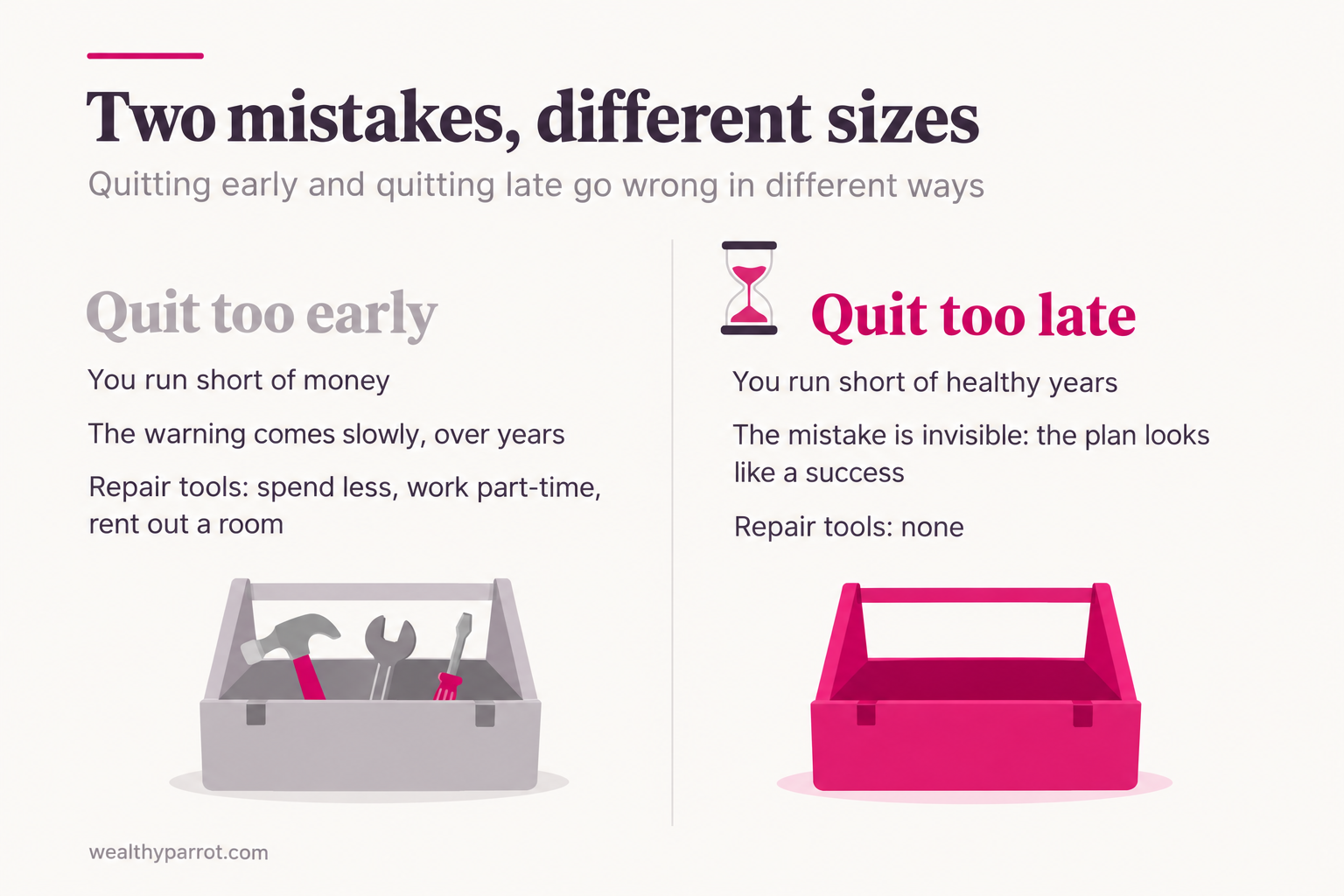
So when the numbers are close, let the asymmetry tip the call. Quitting slightly early leaves you options, and working too long uses them up.
When one more year is the right call
None of this means the extra year is always a mistake. The backtest shows when it earns its keep. At a 5% withdrawal rate, only 32 of the 59 40-year retirements survived, so a portfolio that is genuinely short has a real reason to keep growing.
The same goes for a plan that only passes on US history. If you take the 38-country evidence seriously, 4.2% is short. Wade Pfau, a retirement researcher, calls working longer the most powerful fix for a plan that falls short.
There are other honest reasons. A big known expense, like a child's university or a house repair, makes working to fund it a plan rather than a syndrome.
Pension rules also matter. In many systems an extra year means another year of contributions, one fewer year of payments, and sometimes a bonus for claiming later. The OECD puts the fair bonus for a one-year delay at 4.8% on average. That's the bonus that leaves lifetime pension value unchanged, and it ranges from below 4% to around 6% by country.
Crossing a threshold of age or contribution years can be worth more than a year of portfolio growth. The details differ by country, so check your local rules.
And there are cheaper versions of the extra year. Barista FIRE means leaving the career for part-time work that covers part of your costs. Earn €15,000 a year part-time, and the portfolio only has to fund €23,000.
On €900,000, that's a withdrawal rate of 2.6% - lower than three more full-time years would have bought, and close to the 38-country estimate. My FIRE calculator models this path.
A sabbatical works as a dress rehearsal. Three to six months off tells you what your days actually cost and whether you miss work. No spreadsheet has that data, and you only collect it by trying.
Practical takeaways
- Calculate your withdrawal rate today. Divide annual spending by your portfolio. In my US backtest every 40-year retirement at 3.4% survived; the 38-country evidence points nearer 2.3%. Between the two is where the extra-year debate is worth having.
- Set a date, not a number. Perkins calls it your net worth peak, the point where you stop adding and start spending down. A target number keeps moving, but a birthday doesn't.
- Price the year in healthy years. Eurostat puts healthy life left at 20.4 years at 50 and 10.3 at 65, EU average.
- Run the "fired on Friday" test. If your plan works without the next pay cheque, the extra year is a choice.
- Model part-time before full-time. Even €15,000 a year of part-time income can cut your withdrawal rate more than another full year at work.
- Check your pension thresholds. Some countries reward a specific age or contribution record; those are worth reaching, and they're a reason with an end date.
- Ask who benefits from the advice to keep going. A percentage-of-assets fee grows with your pot and shrinks when you spend.
Back to January
So, the spreadsheet again. €900,000, €38,000 a year, 4.2%, and 48 of 59 US histories survived without a single change in spending. The first extra year would add seven points to that. It would also come out of a window of roughly twenty healthy years, at an age when your knees still vote yes.
Next January, before you type "one more year", write two numbers side by side: what the year buys in percentage points, and what it costs in healthy years. If the first is small and the second is not, close the spreadsheet and pick a date.
If you want the other half of this story, how to spend once you stop, I covered it in the hardest part of FIRE isn't saving, it's spending.