Should you buy the extended warranty? The one rule for deciding what to insure


You have picked the TV. It costs €899, it has a Black Friday sticker on it, and your card is already in your hand.
Then the question comes. "Would you like to add three years of cover for €149? Just in case."
Did you say yes the last time someone asked you that? Plenty of smart people do. The offer arrives at the exact moment you have committed €899 to a fragile box, and €149 sounds like a small price for never thinking about it again.
I want to give you a way to answer it in ten seconds, at any till, for any product, and it also tells you which insurance to buy more of. First, let's see what that €149 actually buys.
"It's only 15%, and it buys peace of mind"
The common answer goes like this. The warranty costs about a sixth of the TV, TVs break, and repairs are expensive. Peace of mind is worth something too, and all of that is true.
What the answer leaves out is how much of that €149 is likely to come back to you as repairs. That is the one number that matters. Peace of mind is a real product, and like any product it has a price. The seller knows that price to the cent (spoiler, it is a lot less than the €149 on the sticker).
You, meanwhile, are asked to guess it at a checkout, with a queue behind you. So let's work it out the way the seller does.
How an insurer prices a policy
Every insurance premium, for a car, a house or a TV, is built from two layers. The bottom layer is the pure premium, the money the insurer expects to pay out in claims. The top layer is the loading, which covers the insurer's running costs, the seller's commission and the profit.
An Italian insurance textbook, Le assicurazioni by Giovanni Cucinotta and Laura Nieri, has a clean example. Insure 1,000 cars, of which 10% have a claim each year, at an average cost of €800.
The insurer expects to pay €80,000 in total, so the pure premium is €80 per car. Everything a driver pays above €80 is loading.
Think of it like a casino. The roulette wheel pays most of what is bet on it back to the players, and the house keeps a slice of every spin (the house, of course, always knows its odds). Nobody calls the casino a scam for that, because the slice is the business. An insurer runs the same game, betting that bad luck stays rare and averages out across thousands of customers.
That has an uncomfortable consequence. Every insurance policy loses money for the average customer. It has to, or the insurer could not pay its staff. So the useful question is how much you lose on average, and what you get in return for that loss.
The 36p question
For most products nobody publishes the split between claims and loading. The UK is an exception. Its regulator, the Financial Conduct Authority, makes insurers report what share of premiums they pay back in claims, product by product.
The 2025 figures, published in July 2026, are worth a look. Car insurance paid out 59p in claims for every £1 of premium, and home insurance paid out 48p.
Gadget insurance, the cover sold for phones, laptops and other electronics, paid out 36p, down from 42p the year before. The regulator put the drop mainly down to higher premiums.
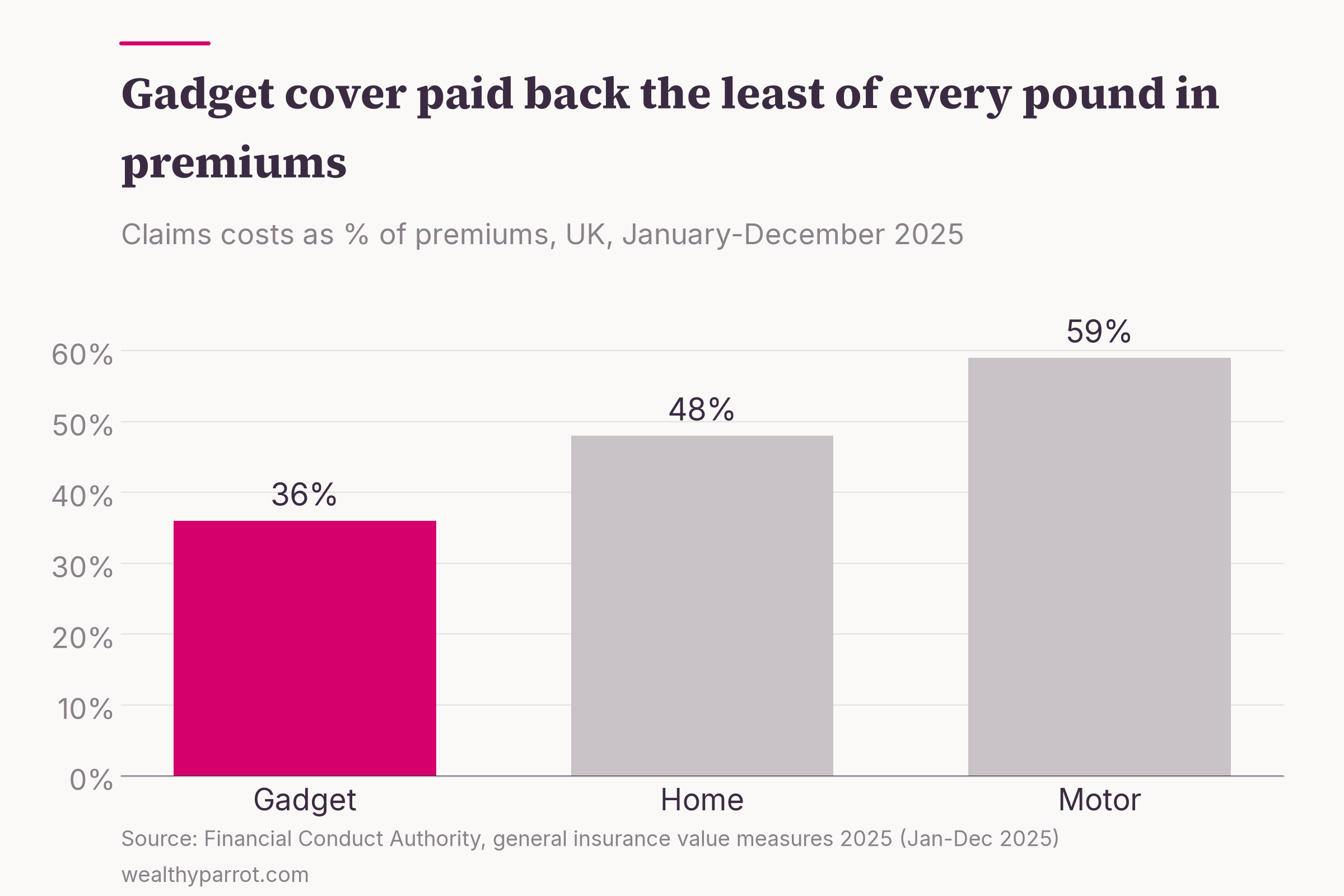
Look at it from the customer's side. For every £100 people paid to insure their gadgets, £36 came back as repairs and replacements. The other £64 paid for staff, commissions, marketing and profit.
Now borrow that ratio for the TV, purely as an illustration. If the €149 warranty paid back at the same rate as UK gadget cover, buyers as a group would get about €54 of it back in repairs. The remaining €95 would be the price of the peace of mind. Put that way, the question at the till becomes whether three years of not worrying about one TV is worth €95 to you.
Some people will still say yes. But the seller never asks the question in those words, and buyers who see the real numbers answer it differently (more on that below).
Fun fact: UK customers held 7.5 million gadget insurance policies in 2025. That year the premiums they paid rose 3%, while the claims costs insurers covered fell 12%, according to the Financial Conduct Authority.
Even car and home cover lose customers 41p and 52p of every pound on average. So a low payout alone cannot be the reason to skip a policy, or nobody would insure their house. The rule below explains what separates the TV from the home.
The one rule
The rule fits on a sticky note. Insure what would ruin you. Pay for what would only annoy you.
Economists put it more formally. John Campbell and Tarun Ramadorai, in their book Fixed, start from "actuarially fair" insurance, where the average customer gets back exactly what they pay in. Real insurance always costs more than that.
The bigger the markup, and the more you can lose without real harm, the more of the risk you should carry yourself. Their practical advice is blunt. Insure large risks, choose high deductibles (the part of each claim you pay yourself before the insurer pays anything), and skip insurance on small risks such as extended warranties.
Why does size change the answer? Because losing €899 and losing €300,000 are different kinds of event.
Imagine two households, each with €5,000 in an emergency fund. If either one's TV dies in year three, they grit their teeth, buy a new one and carry on. If one of them floods the flat below, or a cyclist sues after a crash, that household could be paying for a decade.
For the TV, you are buying protection against a loss you can already absorb, and paying a markup for it. For the flood, you are buying protection against a loss you could not absorb at all. Both premiums carry a loading. Only the second buys you something you could not provide yourself.
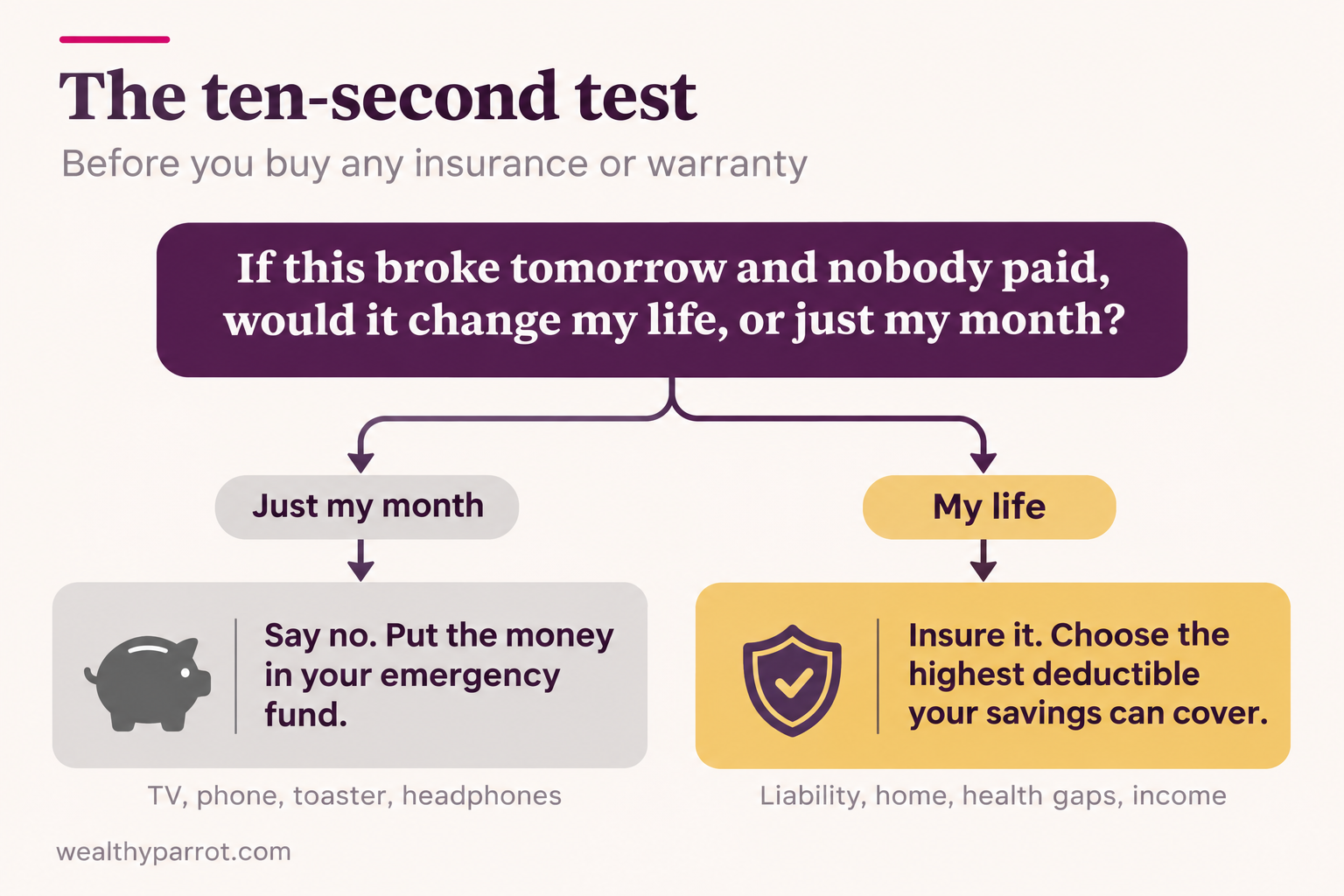
So the ten-second test at the till is one question. If this thing broke tomorrow and nobody paid, would it change my life, or just my month? If the honest answer is "my month", say no.
The rule also comes down to who carries the risk. An insurer can sell warranties profitably because it holds thousands of them, and the breakdowns average out. One TV on its own does not average out, so it feels like a gamble. But over twenty years you will buy dozens of phones, laptops and washing machines.
Think of that drawer of gadgets as your own small insurance pool. If you decline every warranty and put the money aside, the occasional failure gets paid from the savings on all the ones that never broke. You keep the loading the insurer would have kept.
You may already own a two-year warranty
European shoppers have an extra reason to hesitate, and the seller rarely brings it up.
Under EU law (Directive 2019/771), anything you buy from a business comes with a legal guarantee of at least two years. If the product turns out to be faulty, the seller has to repair or replace it, or give you a price cut or a refund. It costs you nothing extra (yes, really, it is already in the price of the TV).
Countries may give more. Spain, for example, gives three years on goods bought since 2022, according to its consumer ministry.
There is also a rule about proof. If a fault shows up in the first year, the law presumes it was there on the day of delivery, so the seller has to prove otherwise. Some countries, Spain and France among them, extend that presumption to two years. Once it ends, it is usually up to you to show the fault was not your doing.
Two newer EU rules make the free cover longer and easier to spot. Under the 2024 right-to-repair directive, choosing a repair under the legal guarantee extends the seller's liability once by 12 months, a rule countries had to adopt by 31 July 2026.
And from 27 September 2026, every shop selling to consumers in the EU has to display a standard notice about the legal guarantee, in store and online. Look for it near the till where the warranty is being sold.
The legal guarantee covers faults, not the phone you dropped in a canal. But it changes the arithmetic of that €149. A three-year warranty bought with the TV overlaps the legal guarantee for two of its three years, at least for manufacturing faults, so part of what you are offered, you already own.
When something does break, contact the shop first, because the legal guarantee is the seller's responsibility, not the manufacturer's. Keep the receipt or order email for as long as the guarantee lasts.
The UK, outside the EU since 2020, has its own rules. Under a 2005 order, electrical retailers must show the warranty's price next to the product and give you a written quote on request, valid at that price for 30 days. Cover longer than a year can be cancelled within 45 days for a full refund if you have not claimed.
So you can walk out, think it over at home, and still buy the same cover later. Other countries have their own rules, so check yours.
Who profits from the default answer
If warranties pay back so little, someone is doing very well out of them. In 2003 the UK's Competition Commission looked into warranties on household electrical goods. According to a summary in the trade journal Warranty Week, five retailers sold about 81% of them in 2001. Those five earned between £116 million and £152 million a year more than a normal return on their capital.
Warranties work like the add-ons airlines bolt onto a cheap fare, where the money is made after you have already said yes. But why do so many people say yes?
A 2019 study of the extended warranty market used purchase data from a major US electronics retailer. About one in four TV buyers took the warranty, paying $90 or more on average to insure against a loss of at most $400, with a 7% chance of happening. At those odds the cover was worth no more than $28.
The researchers found that buyers behaved as if a 5% chance of failure were a 13% chance, and that this, more than market power or plain caution, explained the demand and the profits. In an experiment, people told the real failure rate were willing to pay about half as much.
Fun fact: According to the same study, Best Buy trains its sales staff to offer the warranty only after the customer has decided to buy the TV. Business Week estimated in 2004 that warranties made up almost half of Best Buy's operating income the year before.
The seller knows the failure rate. You do not, and your imagination fills the gap with a cracked screen.
Why smart people buy it anyway
If you have bought one of these warranties, you are in good company. An analysis of home-insurance customers at one large US insurer found that 83% paid extra for a deductible below the $1,000 maximum. The most popular group paid $100 a year to cut it to $500, for cover worth less than $25 a year, five times its value.
Fun fact: To make that $500 deductible worth its price, a customer would have needed to expect a claim rate of about 18%, roughly five times the real one, according to the same study.
Being clever does not switch this off. Two researchers who surveyed warranty buyers in the field found that people greatly overestimate both the chance of a breakdown and the cost of fixing it. The best predictor of buying was the emotional benefit people expected, and buyers with stronger cognitive skills were still swayed by it.
A 2011 paper on getting more happiness from money adds that people overestimate how bad a loss will feel, and notes warranty prices reaching as high as 50% of a product's price. Its fourth rule is to "eschew extended warranties and other forms of overpriced insurance".
None of this makes the buyers foolish. It makes them human, standing at a checkout with a fragile box in their arms, which is exactly where spending triggers do their best work. A warranty on a toaster is like a seatbelt on a sofa. It feels responsible, and it protects you from almost nothing.
Where the rule says yes
The rule cuts both ways, and the second half matters more. A household that pays €149 to protect a TV may still have no cover for the risks that could actually sink it. Which of these do you have today?
Liability insurance pays if you accidentally injure someone or damage their property, a loss with no obvious ceiling, and it is often bundled with home contents cover. Home cover protects what savings could not replace, and health cover matters wherever public healthcare leaves gaps. Income protection pays part of your salary if illness stops you working (your future earnings count as an asset too). Each passes the ten-second test easily.
Fun fact: After Hurricane Katrina in 2005, the number of US flood insurance policies rose, then fell back to pre-Katrina levels within three years, according to The Ostrich Paradox by two Wharton professors. Many households let the cover lapse as the memory faded.
Then apply the rule inside the policies you keep. Raising your deductible lowers your premium because you carry the small claims yourself, which is exactly the trade the rule recommends.
Dutch adults are offered it every year. On top of a compulsory health deductible, they can choose an extra €500 for a lower premium. Between 2013 and 2018 the average discount was €232, yet only 5% to 8% took it, and the researchers found habit weighed more than health.
There are honest exceptions (no, the rule does not say "never"). If you have no savings yet and could not replace the laptop you work on, cover may be worth its markup for now. As your emergency fund grows, more things move from "would ruin me" to "would annoy me".
Practical takeaways
- Run the ten-second test at the till. If losing the item would change your month rather than your life, decline the cover.
- Build a self-insurance pot. Put what you would have spent on warranties into your emergency fund. Whatever you don't need, you keep.
- Check what you already have. In the EU that is at least two years of legal guarantee, plus 12 more months if you choose a repair. Some bank cards and home policies add purchase or accidental-damage cover too.
- Raise the deductibles on the policies you keep. Carry the small claims yourself and pay less for the big protection.
- Insure the big things properly. Liability, home, health gaps and income are where the markup buys something you cannot buy any other way.
The €149 you keep
Back at the till, with the €899 TV. You now know how the €149 is built. A share of it would come back as repairs, the rest pays the seller's margin, and two of the three years overlap a guarantee you already have.
So say no, and do one small thing on the way home. Move €149 into your emergency fund. If the TV dies in year three, that money pays for a good part of a new one. If it doesn't, the money is still yours, and you have just insured yourself at cost.