
A diamond is forever. De Beers wasn't
De Beers spent 130 years convincing the world a diamond never loses its value. In July 2026, the company itself sold for less than the price of a new mine shaft.


On 29 July 2026, Bloomberg published a sentence that would have read like satire twenty years ago: Anglo American is in talks to sell De Beers - the company that invented the modern engagement ring - for about $1 billion.
That is not a typo, and it is not for a struggling division or a minority stake. It is roughly the price tag on the mining rights alone, let alone the actual mine, that a serious new diamond deposit costs to develop. The company whose slogan convinced generations that "a diamond is forever" is changing hands for less than the cost of sinking a single new mine shaft.
De Beers never really sold diamonds. It sold scarcity, and then it sold the feeling scarcity produces: desire. For over a century, that formula worked so well that "diamonds are forever" became one of the most successful lies in the history of advertising - successful enough that most people never questioned it.
Here is how the company that manufactured "forever" ran out of road.
The company that invented desire
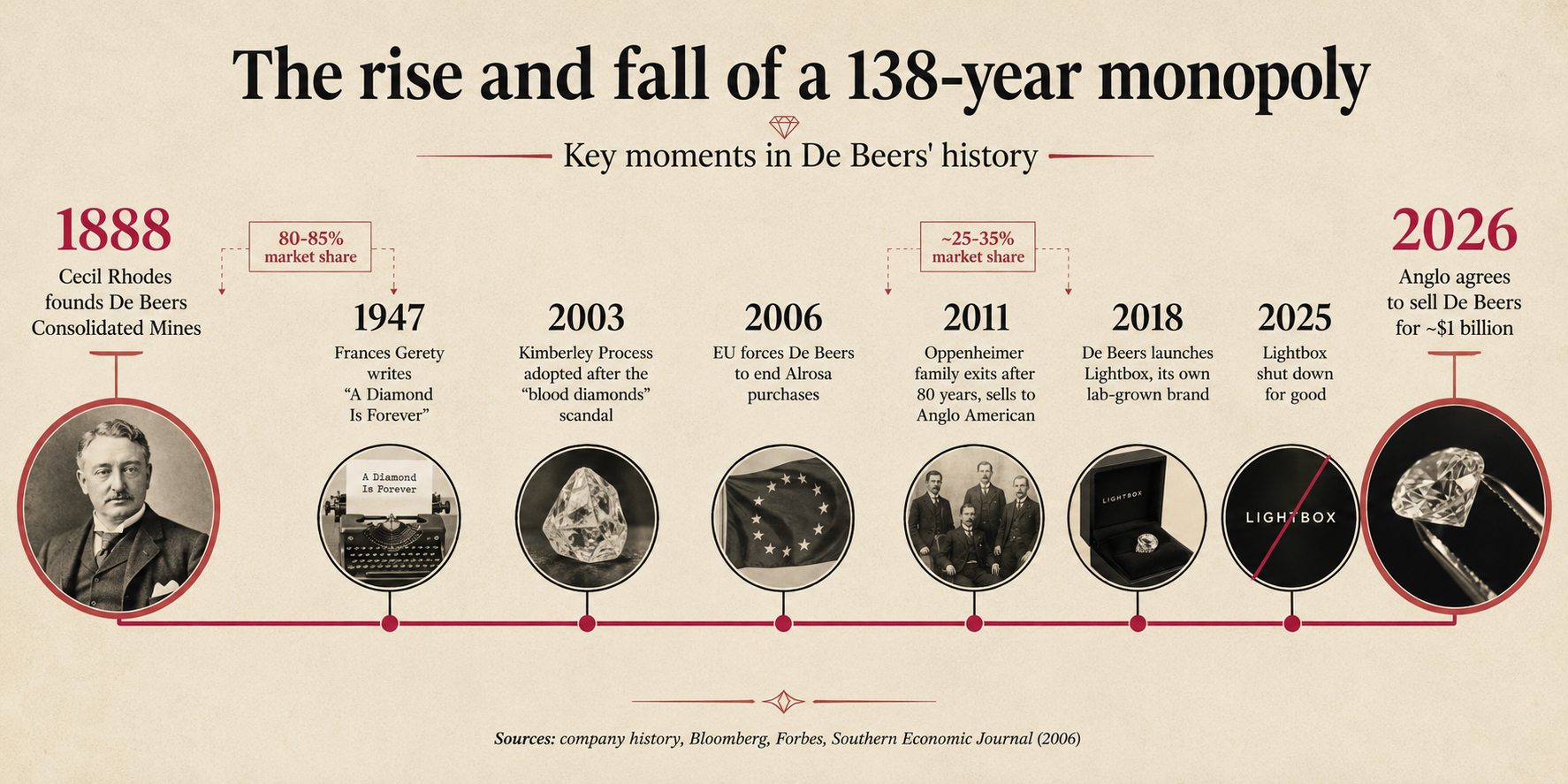
Cecil Rhodes founded De Beers Consolidated Mines in 1888, buying up the claims of rival diggers scrambling over South Africa's Kimberley diamond fields until one company controlled almost all of it. By the time Rhodes died in 1902, De Beers already dominated global rough-diamond supply, and over the following decades - especially under the Oppenheimer family, who took control in the 1920s - that dominance hardened into one of the most durable cartels in industrial history, peaking at 80-85% of the world's rough diamond supply, and touching close to 90% at points.
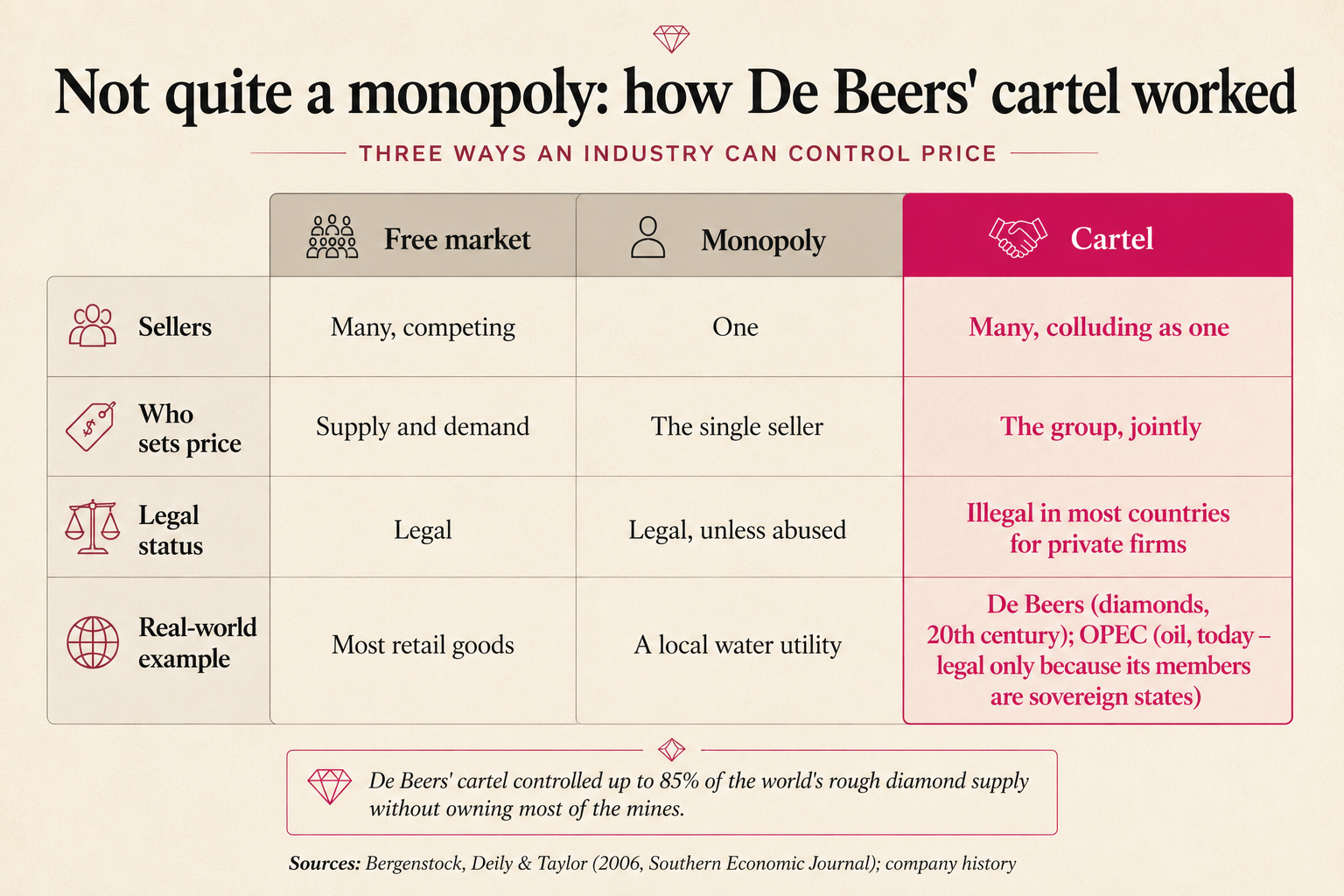
The mechanism was elegant and ruthless. De Beers ran the Central Selling Organisation (CSO) - the cartel's trading arm, based in London - which acted as buyer of last resort for the entire industry: when new mines came online or demand softened, De Beers bought the surplus and locked it in vaults rather than let it hit the market. Ten times a year the CSO staged "Sights" - sealed, non-negotiable boxes of rough diamonds offered to a hand-picked list of "Sightholders." You took the box at the price and mix De Beers set, or you were cut off from the world's diamond supply entirely. By then, De Beers had effectively become a marketing company that happened to own mines.
That threat had teeth. When Zaire (a major diamond producer, now the Democratic Republic of Congo) tried to break from the cartel in the early 1980s and sell independently, De Beers dumped stockpiled supply and crashed the price of Zaire's diamonds by roughly 40% - and did it again in 1996 when Argyle, Australia's biggest mine, tried the same move. Both episodes are documented in a 2006 academic study of the cartel's own trading data. Leaving De Beers wasn't inconvenient. It was engineered to be ruinous.
Fun fact: what De Beers ran was, legally speaking, a cartel - and cartels are illegal almost everywhere, including under US antitrust law. De Beers dodged prosecution for most of the 20th century simply by not operating directly in the US, only pleading guilty to a price-fixing charge in 2004 once it wanted back into the American market. The most famous cartel still operating in the open today, OPEC, sidesteps the same law for a different reason: its members are sovereign governments, and antitrust rules don't reach states.
Controlling supply was only half the job. Diamonds are not rare - geologically, they're common - so De Beers had to manufacture the belief that they were precious. In 1947, a 31-year-old copywriter at the N.W. Ayer agency named Frances Gerety wrote four words that did exactly that: "A Diamond Is Forever." Advertising Age later named it the greatest advertising slogan of the 20th century. Gerety, who worked the De Beers account until 1973, never married. The slogan wasn't just about selling rings. It quietly killed the resale market too. If diamonds are "forever," reselling one reads as a betrayal of the marriage it symbolizes rather than a financial decision - which meant fewer used diamonds ever came back onto the market to compete with new ones on price.
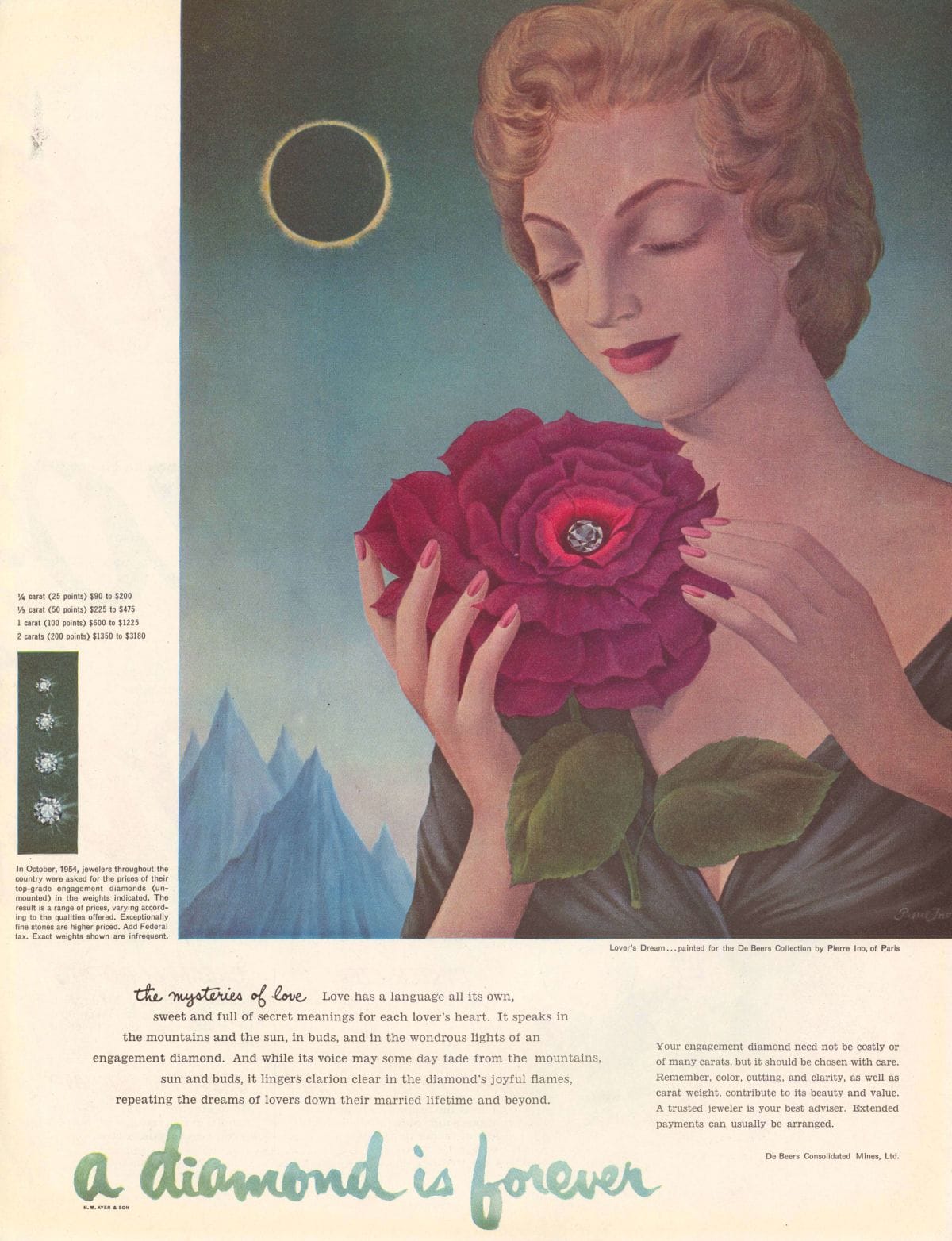
De Beers then engineered the specific amount you were supposed to spend. Depression-era ad copy in the 1930s suggested a suitor spend roughly one month's salary on a ring. By the 1960s and into the 1980s, the benchmark had doubled to two months' salary in the US, and some markets - notably Japan, where diamond engagement rings barely existed before targeted De Beers marketing - were pushed toward three months. None of this reflected the diamond's resale value, which was close to zero - it reflected the buyer's paycheck, the only number a company selling manufactured desire actually needs to know.
How the monopoly rotted
Three forces cracked a cartel that had survived world wars and the Great Depression.
The first was reputational. Through the 1990s, reporting on "blood diamonds" - conflict stones from Sierra Leone, Angola and elsewhere funding civil wars - forced the industry into the Kimberley Process Certification Scheme, adopted in 2003. It didn't end De Beers' market power directly, but it made the old strategy of quietly buying up uncertified rough from anywhere much harder to run - a certification-and-cooperation fix with the same basic shape, and the same basic limits, as the international sanctions regimes built to choke off other conflict economies.
The second was supply. Independent deposits - Alrosa in Russia, the Ekati and Diavik mines in Canada's Northwest Territories, and Rio Tinto's Argyle mine in Australia - came online and, crucially, chose to sell independently rather than funnel their output through De Beers' vaults. A monopoly built on being the only buyer stops working once sellers have somewhere else to go. Even Russia was too big to punish the Zaire way: when the collapsing Soviet Union leaked an estimated $1 billion a year in diamonds between 1993 and 1996, De Beers just bought the excess into its own stockpile, keeping annual purchases above $4 billion rather than start a price war it couldn't win.
The third was regulatory, and it was the one that actually broke the mechanism. De Beers had long purchased up to half of Russia's rough diamond output from Alrosa specifically to keep controlling global supply. In February 2006, the European Commission accepted binding commitments from De Beers to phase out those purchases entirely, and by 2009 the arrangement was gone. Deprived of its ability to absorb the world's second-largest producer's output, De Beers' market share fell from its historic peak toward what most trade analysts now put at roughly a quarter to a third of global supply - a number that moves depending on whether you count by volume or by value, but the direction is not in dispute.
With the cartel model no longer defensible, the Oppenheimer family made its exit. On 4 November 2011, after 80 years of family control, the Oppenheimers sold their remaining 40% stake in De Beers to Anglo American for $5.1 billion - an implied valuation around $12.75 billion - taking Anglo's stake to 85%, with the Government of Botswana holding the remaining 15%. De Beers had gone from a private family cartel to a subsidiary of a public mining company answering to quarterly earnings calls. That transition mattered more than it looked like at the time - a family dynasty can afford to think in decades, but a public company reporting to shareholders every quarter can't.
Compare that to ASML's chipmaking monopoly, built on physics no rival can copy. De Beers' monopoly rested on supply and belief - both far easier to route around.
The lab-grown revolution, and De Beers' own unforced error
While regulators and rival mines were eroding De Beers' supply-side control, a completely different threat was forming in laboratories: diamonds that are chemically, physically and optically identical to mined stones, grown rather than dug.
Lab-grown diamonds are not cubic zirconia or moissanite - simulants that merely look like diamonds. They are pure crystallized carbon in the same lattice structure as a mined stone, produced by one of two methods: HPHT (high pressure, high temperature), which replicates the conditions found deep in the earth's mantle using industrial presses, or CVD (chemical vapor deposition), which builds a diamond layer by layer from carbon-rich gas in a vacuum chamber. Under a jeweler's loupe, there is no reliable way to tell one from the other without specialized equipment. The technology isn't new either - the first synthetic diamond was grown in a lab in 1955, though gem-quality synthetics didn't arrive until the 1980s, at tens of thousands of dollars a stone. What changed since is cost, not chemistry: a stone that cost around $4,000 to manufacture in 2008 costs an estimated $200-300 today.
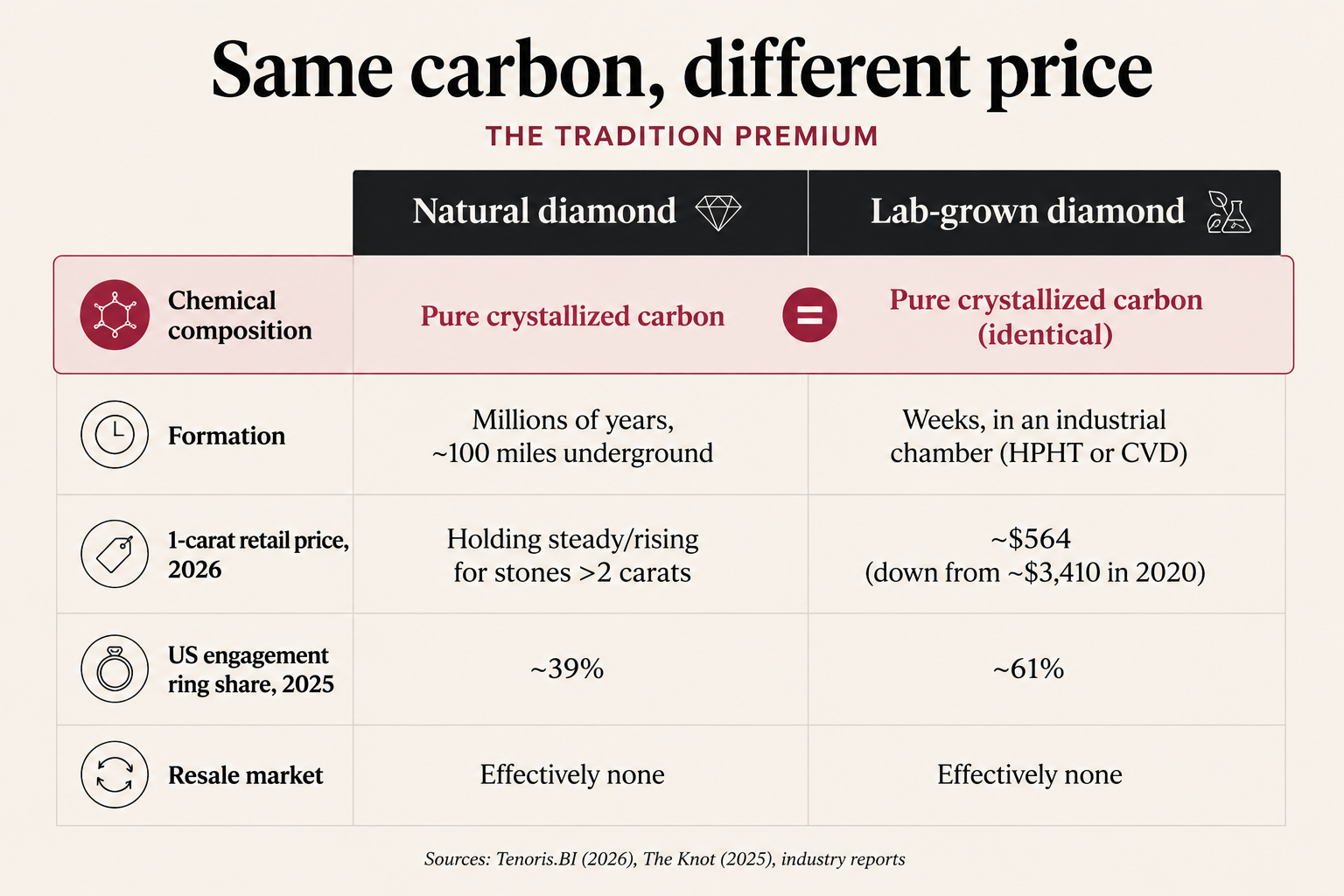
China, and specifically Henan province, became the industrial engine of this shift, churning out HPHT stones at massive scale, while Surat in India - which already cuts and polishes something like 80-90% of the world's natural rough diamonds - adapted its factories to cut and polish lab-grown stones too. The result was a supply glut that crushed prices. A one-carat lab-grown diamond that retailed for roughly $3,410 in 2020 was selling for closer to $564 by May 2026 - a decline various industry trackers put anywhere from three-quarters to as much as 90% since 2020, depending on the segment and the exact dates measured.
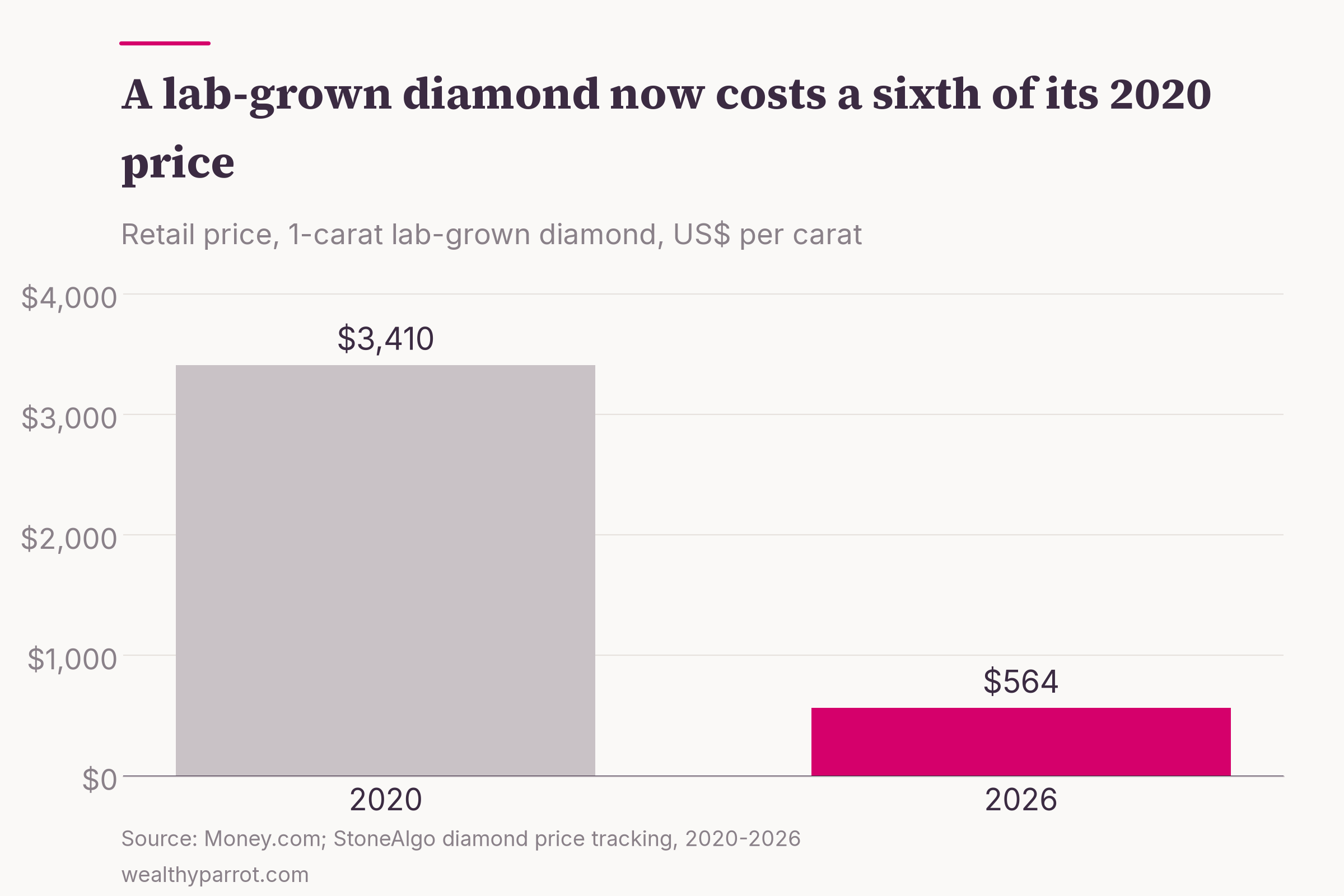
Fun fact: by 2025, lab-grown stones reportedly accounted for as much as 61% of US engagement ring center stones - up from the single digits just six years earlier. Consumers didn't reject the tradition De Beers built. They just stopped paying a mined-stone premium for it.
De Beers' response is the article's genuine unforced error. In 2018, the company launched Lightbox, a standalone brand selling only lab-grown stones at a flat, transparent price of $800 per carat - a fraction of what an equivalent mined diamond commanded. The strategic logic was to box lab-grown diamonds into "fashion jewelry," a lower, separate tier that would leave the natural-diamond bridal market untouched. De Beers built a $94 million manufacturing plant in Gresham, Oregon in 2020 to supply it.
It backfired immediately. By putting its own name on lab-grown diamonds, the authority on what makes a diamond "real" told the market lab-grown was legitimate - and then Chinese HPHT producers undercut Lightbox's own pricing. Lightbox lost $101.3 million in 2023 alone. De Beers cut its price to $500 a carat in May 2024 in a last attempt to compete, and on 8 May 2025, CEO Al Cook announced Lightbox was closing for good. For 130 years, De Beers had insisted only mined diamonds were "real." Its own brand ended up proving the opposite, at exactly the moment it could least afford to.
The fire sale
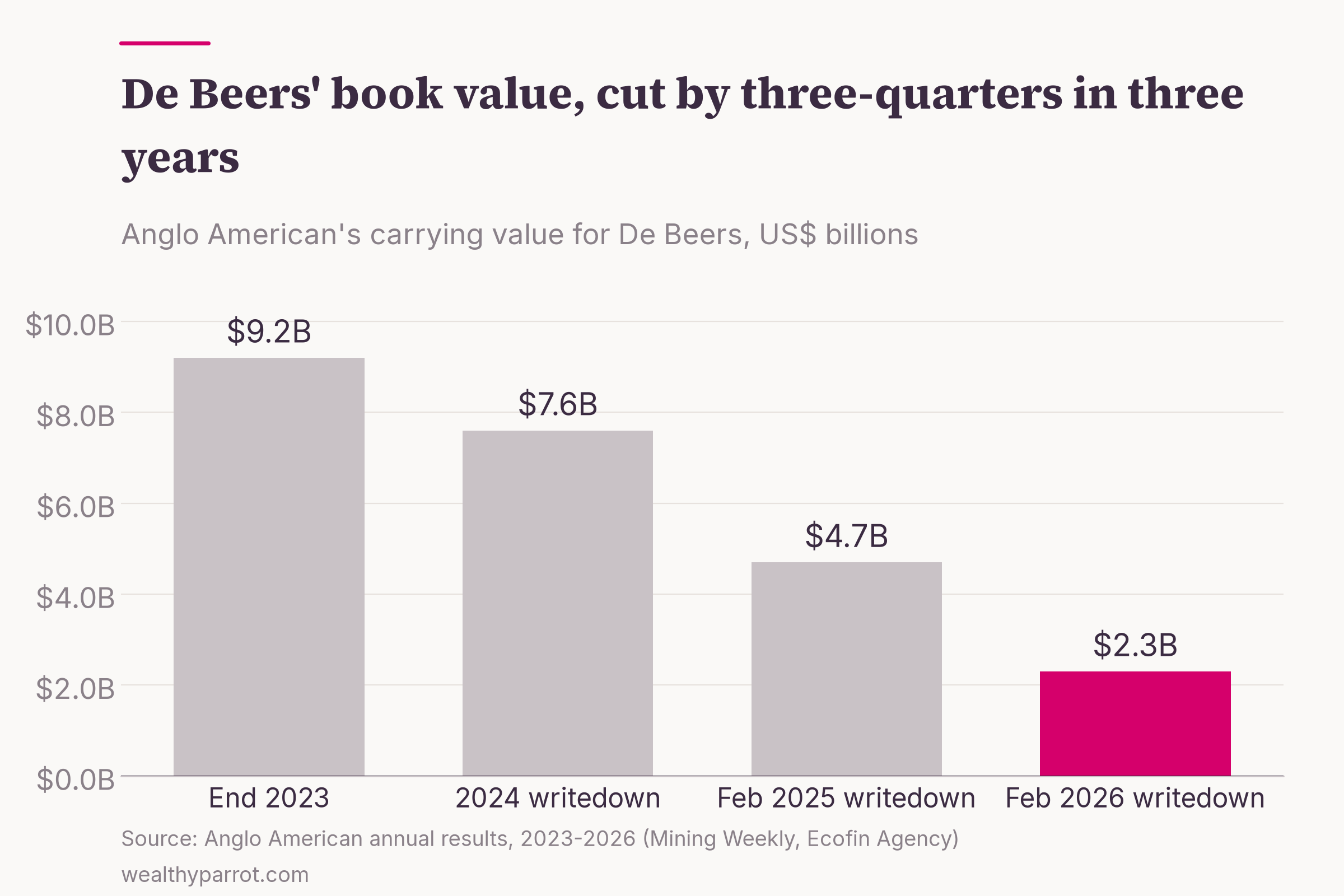
The numbers behind the 2026 sale read like a company in freefall. Anglo American carried De Beers on its books at $9.2 billion at the end of 2023; three annual impairments later - about $6.8 billion in cumulative writedowns - the carrying value was just $2.3 billion by February 2026.
De Beers posted an underlying EBITDA loss of $511 million in 2025, and Anglo's own results for that year showed a statutory loss of $3.7 billion, almost entirely attributable to the De Beers writedown. First-half 2026 results, published 30 July, showed average realized rough-diamond prices down 32% year-on-year to $105 a carat - though Anglo's own commentary drew a clear split: smaller, lower-quality stones remain under sustained pressure from synthetics, while stones above two carats have held their value.
The sale is tangled up with a bigger corporate story. In early 2024, BHP Group made a roughly $49 billion approach for Anglo American that explicitly proposed breaking the company up and divesting De Beers, platinum and coal. Anglo rebuffed it but took the lesson, simplifying anyway - exiting coal and platinum, then agreeing to merge with Teck Resources to build a copper-focused champion. BHP returned with a second, roughly £40 billion approach in November 2025 to disrupt the Teck deal, was rebuffed again, and withdrew for good. De Beers' sale reads as part of that broader simplification, not a single panicked defense against one bid.
The buyer is a name the diamond trade knows well: Gareth Penny, who spent 22 years at De Beers and Anglo American and led De Beers as CEO from 2006 to 2010 - through the 2008 financial crisis - and now chairs the asset manager Ninety One. His Global Diamond Consortium brings together the governments of Namibia and Angola alongside major diamond trading houses including Diarough, Pluczenik and Rosy Blue. Anglo named the consortium its preferred bidder on 17 July 2026, and terms reported twelve days later put the price at roughly $750 million upfront plus $250 million in deferred, performance-linked payments - plus a further $500 million of fresh capital injected into the business - cash now, earn-outs later, fresh capital for control, a structure familiar to anyone who's read how leveraged buyouts actually work. Penny has reportedly said reviving demand will take $200-300 million a year in category marketing, which tells you how much of the old De Beers playbook - manufacture desire, don't just mine rock - the new owners think they still need.
Anglo's CEO, Duncan Wanblad, has said the company chose a private sale over a public listing because equity markets can't absorb a standalone diamond miner right now - worth remembering next time a hyped IPO gets sold to retail investors as the obvious exit.
The human cost
While that played out in London boardrooms, the country most exposed to it was living through a real fiscal crisis. Debswana, the 50/50 mining joint venture between De Beers and the Botswana government, cut its 2025 production target by roughly 40% as revenue fell by around half. Botswana's fiscal deficit hit an estimated 11% of GDP in 2025 - reportedly the largest in sub-Saharan Africa that year - on top of real GDP contractions in both 2024 and 2025, confirmed against IMF data. Botswana drew emergency financing - $304 million from the African Development Bank and $200 million from the OPEC Fund, both in 2025 - just to manage the shortfall. The IMF does see relief ahead, with growth forecast to rebound to 4.7% in 2026, though that assumes the market has found its floor, not that it's still falling.
It is worth sitting with how far that is from where this story started. At independence from Britain in 1966, Botswana had roughly 12 kilometers of paved road and 22 university graduates in the entire country, according to Alan Beattie's False Economy. When vast diamond deposits turned up soon after, founding president Seretse Khama did something almost nobody in his position had done before: instead of nationalizing the mines and pocketing the proceeds, he locked his own government into a strict, transparent revenue-sharing partnership with De Beers - a "credible precommitment," in Beattie's framing, that assured De Beers its profits were safe from future political raiding, in exchange for honest accounting and steady infrastructure investment for Botswana. A landmark 2001 study by economists Daron Acemoglu, Simon Johnson and James Robinson credits exactly this institution-building for Botswana avoiding the usual resource curse. Botswana went on to become the world's fastest-growing economy for roughly three decades, funding roads, schools and a sovereign wealth fund almost entirely on diamond money.
Botswana still holds a 15% equity stake in De Beers itself, and President Duma Boko said in January 2025 that roughly 70% of De Beers' entire global output now comes from Botswana's mines - a share of sales revenue set to shift further in Botswana's favor under a renegotiated February 2025 agreement. Diamonds still account for roughly a quarter of Botswana's GDP and 80-85% of its exports. Lab-grown diamonds are, in almost every meaningful sense, the more ethical choice - no open-pit mines, no conflict financing, a fraction of the carbon footprint - and they bypass Botswana's economy completely, exactly the kind of trade-off worth noticing rather than skipping past. Namibia and Angola are moving the same direction as Botswana, both folding into Gareth Penny's buying consortium: three African diamond-producing governments shifting from supplying a London-run company to owning pieces of it, arriving amid a fiscal emergency rather than a moment of strength.
What comes next
The diamond trade looks to be splitting into two genuinely different markets. Natural diamonds, particularly larger and higher-clarity stones above roughly two carats, appear to be settling into a smaller, higher-margin luxury niche - exactly the segment Anglo's own results describe as resilient even as everything below it gets squeezed. Trade analysts at outlets like Rapaport have started describing the natural-diamond business less as a growth industry and more as a stable, if permanently smaller, one.
Lab-grown diamonds, meanwhile, look to be heading toward a production-cost floor rather than a bottomless collapse. Wholesale lab-grown prices reportedly fell "only" around 26% in 2025 - a sharp deceleration from the steeper drops of the prior few years - suggesting the category is closer to bottoming out than to matching the price of cubic zirconia. Gareth Penny's bet, in effect, is that natural diamonds can still win a narrower argument - rarity, provenance, permanence - if someone is willing to spend $200-300 million a year reminding people why that argument used to work.
The 130-year myth that a single company controlled - manufactured scarcity, manufactured tradition, manufactured "forever" - no longer has anyone left to maintain it full-time. The next chapter of the diamond trade is being written in the HPHT presses of Henan, the cutting floors of Surat, and the boardrooms of Gaborone, Windhoek and Luanda, not in an advertising agency in Philadelphia.
The forever that wasn't
De Beers went from a $17.6 billion company at the start of this century to a roughly $1 billion sale in the middle of it. The illusion of permanent, controlled scarcity that the company spent 130 years building finally met a substitute product it couldn't out-market.
Diamonds, it turns out, might genuinely be forever. The company that convinced you of that wasn't.
Practical takeaways
- A diamond has never been a financial asset, and the data now says so explicitly. There is no liquid resale market, no yield, and - as of 2026 - a chemically identical substitute selling for a fraction of the price. Buy one for what it means to you, never as a store of value.
- Question any "rule" that conveniently benefits the seller. The "two months' salary" engagement-ring benchmark was invented by an advertising agency to maximize spend, not derived from anything about the ring itself. The same instinct is worth applying to plenty of financial "rules of thumb" you'll hear elsewhere.
- Monopolies look permanent right up until they aren't. De Beers controlled 80%+ of a global market for a century, and punished defectors ruthlessly to keep it that way - yet regulation, new entrants and a genuine substitute product still took it apart within twenty years. Don't price "this company's dominance is unshakeable" into an investment as if it's a law of physics.
- If you're buying an engagement ring, the "tradition premium" is now genuinely optional. A lab-grown stone gets you the same carbon crystal at a fraction of the cost - what you're paying extra for with a natural stone is provenance and scarcity, not physics.
- Commodity-dependent economies carry real, measurable risk - and it can move fast. Botswana went from three decades of the world's fastest growth to an 11%-of-GDP fiscal deficit largely because the market for one export commodity shifted. Worth remembering before treating any single-resource economy as a safe, static bet.